
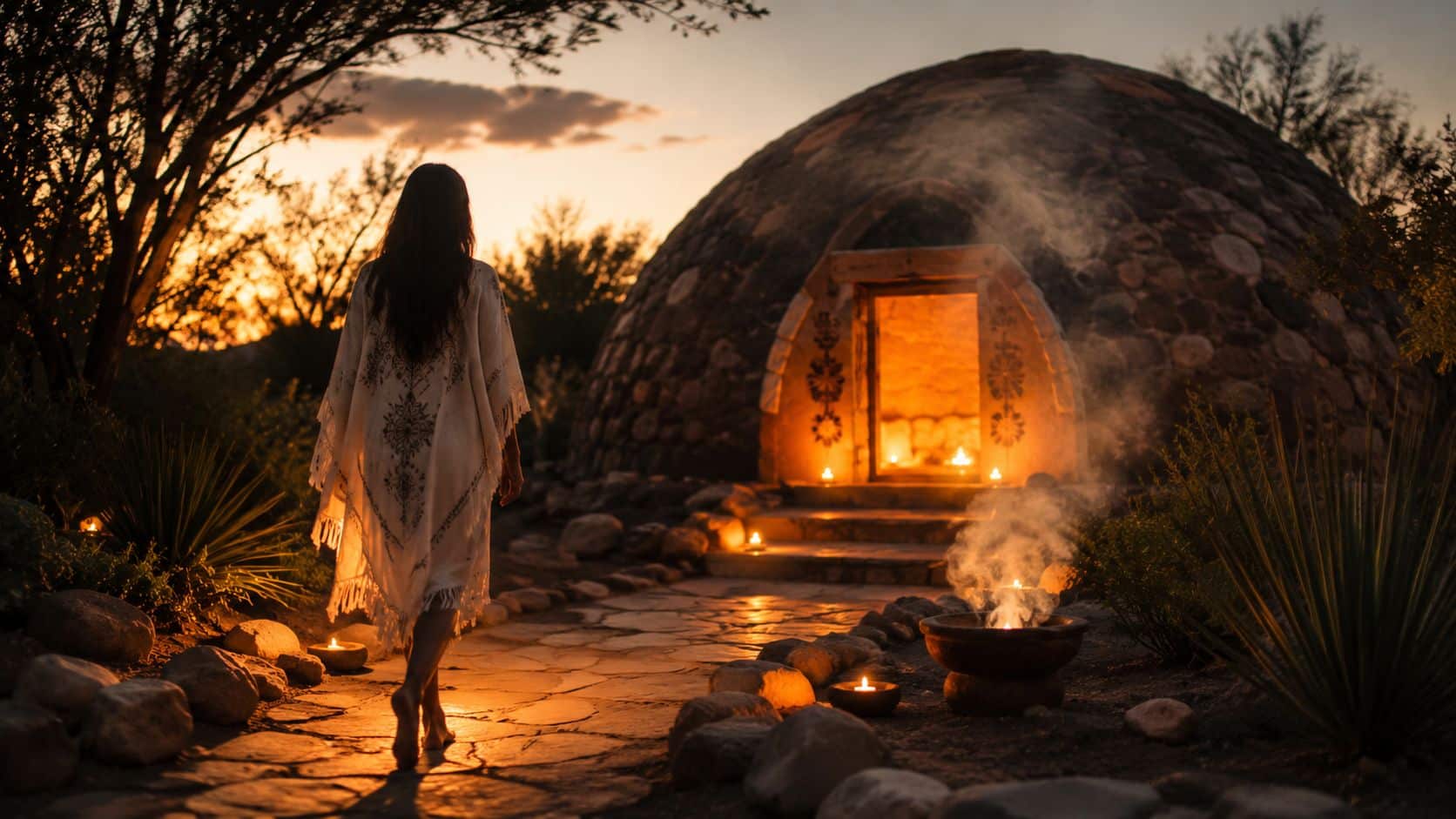
At dusk, the path to a temazcal can feel like a threshold instead of a doorway. The air is often scented with copal, the fire has already changed the stones, and the people waiting outside get quieter as the first round approaches. That pause matters, because the experience is carrying a living Indigenous Mesoamerican lineage, not just a wellness aesthetic or a humid room with a story attached.
A useful way to approach it is to treat the temazcal as a practice with multiple layers at once. It has archaeological roots, a Nahuatl name that means “house of heat”, a ceremony structure with real choreography, and safety considerations that deserve plain language instead of vague spiritual promises. For readers comparing heat therapies, choosing your wellness sauna path can help frame the broader decision, while this guide stays focused on the temazcal itself, its meaning, and its risks.
The best first question is simple. What is being entered here, a generic sauna experience or a ceremony that still carries community memory, ritual order, and cultural weight? That distinction shapes everything from how the room is prepared to how a guest should behave once the door closes. For readers interested in altered states and ceremony context, the internal resource on non-ordinary states of consciousness helps situate the temazcal within a broader contemplative realm.
Origins Rooted in Mesoamerican History
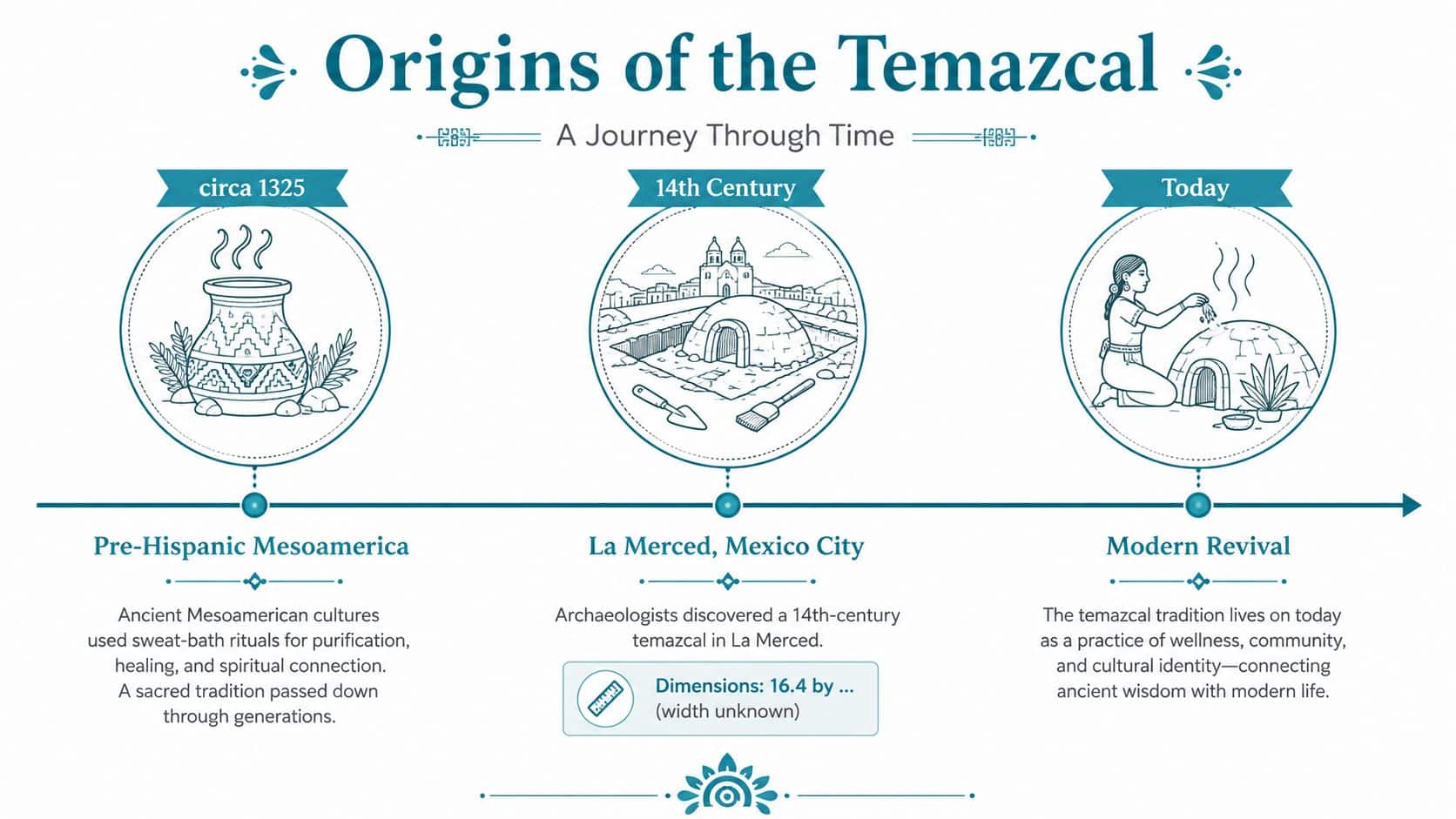
The temazcal is not a modern wellness import with a borrowed indigenous label. It is a pre-Hispanic Mesoamerican steam bath that was already established long before Spanish arrival, and the historical record places it firmly in the region’s medicine, purification, and fertility traditions. Historical sources note that temazcals were in use for at least 700 years before Spanish arrival in 1519 as documented in cultural-historical coverage, which helps explain why the practice still feels rooted rather than revived from scratch.
A striking archaeological marker came from Mexico City’s La Merced neighborhood, where INAH reported a 14th-century temazcal with a footprint of 16.4 feet by 9.7 feet as noted in the historical record. That finding matters because it shows these were not symbolic huts tucked away at the edges of society. They were substantial, purpose-built installations in dense urban settings, which says a lot about how important heat, purification, and ceremony were in everyday life.
Why The Name Matters
The word itself is a clue to the design. A thesis on the Mexican temazcal explains that temazcalli comes from tema, meaning heat, and calli, meaning house, so the phrase means “house of heat” in the linguistic study. That’s more than a poetic name. It encodes the central mechanic of the practice, a heated enclosure rather than an open-air ritual.
That detail also helps distinguish the temazcal from generic sweat bath language. Readers sometimes flatten every steam practice into one category, but the temazcal has its own cultural and linguistic specificity. It was carried through the conquest and remained traditional in Mesoamerica after contact, which makes continuity part of the story rather than an afterthought.
What The Archaeology Suggests
The La Merced discovery and the long pre-Conquest timeline point in the same direction. Temazcals were not fringe experiments. They were woven into a system of medicine, purification, and fertility practice that already had social structure behind it. That is one reason careful language matters, because “spa,” “detox,” or “steam lodge” all miss the deeper historical frame.
A good working rule is this. If the context strips away lineage, it also strips away accuracy. The temazcal is best understood as an enduring Mesoamerican tradition that still lives in Indigenous communities across Mexico and Central America, not as a decorative wellness label someone can use casually.
How The Ceremony Is Structured
The first thing many newcomers notice is that the temazcal has choreography before it has heat. Someone opens the space, the group settles, and the mood changes from social chatter to a more attentive silence. That transition isn’t ornamental, because the ceremony depends on roles, timing, and restraint, not just on steam.
The People In The Room
The temazcalero leads the ceremony, sets the rhythm, and decides how the rounds unfold. Outside the chamber, a fire keeper tends the volcanic stones, often called abuelitas or “grandmothers” in the tradition, while another guide may handle water and support the group. Participants aren’t passive spectators, but they also aren’t improvising the process. The structure depends on trust in the people who know when to open, when to pour, and when to pause.
Inside the room, many traditions use four doors, or four rounds. Each round can represent an elemental direction or a stage of purification, and the room gradually becomes more intense as steam accumulates. A ceremony may include prayer, song, breathing, or guided reflection between rounds, and the point is usually to move deliberately rather than to endure randomly.
“Practical rule: When the guide asks for quiet, quiet is part of the ceremony, not an interruption of it.”
Why The Geometry Changes The Experience
The structure itself matters as much as the ritual. Temazcals are engineered as low-clearance steam chambers, often around 5 to 6 feet high in traditional descriptions, with an upper opening to control venting and a floor slightly above grade to reduce moisture intrusion. A documented replica at Cerén measured 3.4 × 3.4 m with 11.6 m² of interior space according to the Cambridge article. In practice, that constrained volume means the chamber can change quickly when stones are added or water is poured.
That’s why the ceremony is so controlled. Small changes in fire size, stone mass, and opening time can create large shifts in perceived heat and humidity. Experienced facilitators don’t just crank up the fire. They manage placement, water application, and the rhythm of opening and closing so the heat stays legible to the group.
Traditional And Adapted Versions
Community-led temazcals are often held in a local rhythm of use, while resort versions may run on fixed schedules with small group caps and advance booking. The underlying structure can look similar from the outside, but the social meaning can change a lot depending on who leads it and why it’s being offered. That difference matters because the temazcal is not culturally interchangeable with a generic sauna or a borrowed wellness set piece.
Reported Benefits and What They Mean
The appeal of a temazcal is easy to understand. People leave describing release, clarity, rest, or a deep sense of reset. Those experiences are real, but they do not automatically point to a medical cure, and a careful reading keeps the language grounded.
Physical Effects Without The Hype
The body responds to sustained heat in predictable ways. Blood vessels open, circulation changes, sweating increases, and muscles often feel looser afterward. In a temazcal, those effects can be intensified by the chamber’s low clearance, humidity, darkness, and the stop-start rhythm of the rounds, which can make the experience feel more enveloping than a standard steam room.
That said, much of the popular benefit language around temazcal is broader than the evidence specific to the practice. The difference between “people often feel better” and “this treats a condition” matters. The first describes lived experience, the second requires stronger proof.
A simple analogy helps here. Heat can loosen a tight shoulder, but that does not make heat a cure for every cause of pain in the shoulder. The temazcal may create a setting where the body relaxes and tension becomes easier to notice, yet that is different from claiming it fixes a diagnosis.
Psychological Effects Are Part Of The Design
The ceremony also shapes attention. Darkness reduces visual distraction, the group setting adds accountability, and the pace of rounds encourages breath awareness and patience. Those conditions can make the experience feel introspective even when nothing dramatic is happening externally. The result is often a mix of physical exertion and mental stillness, which is why some participants describe it as a clearing practice.
“A useful frame is this. The temazcal can support a wider healing or wellbeing process, but it works best when it stays one part of that process, not the entire answer.”
Wellness marketing often stretches the meaning of every positive feeling. A more honest interpretation is that the temazcal may help some people mark transitions, process fatigue, or prepare for deeper work, especially when it sits alongside plant medicine or integration practices. That makes it a complementary practice, not a standalone cure-all.
The psychological value can also come from the structure itself. Entering a dark, contained space, staying present through rounds of heat, and sharing that space with others can create a sense of containment that everyday life rarely offers. For some people, that is the part they remember most clearly.
A Better Way To Hold The Experience
The strongest benefit claim may be the simplest one. The temazcal gives structure to an experience of heat, ritual, and communal attention. For some people that structure is enough to shift how the body and mind feel for a while, and for others the value lies in the cultural continuity itself. Both readings can be true without turning the practice into marketing copy.
Safety Considerations Most Articles Skip
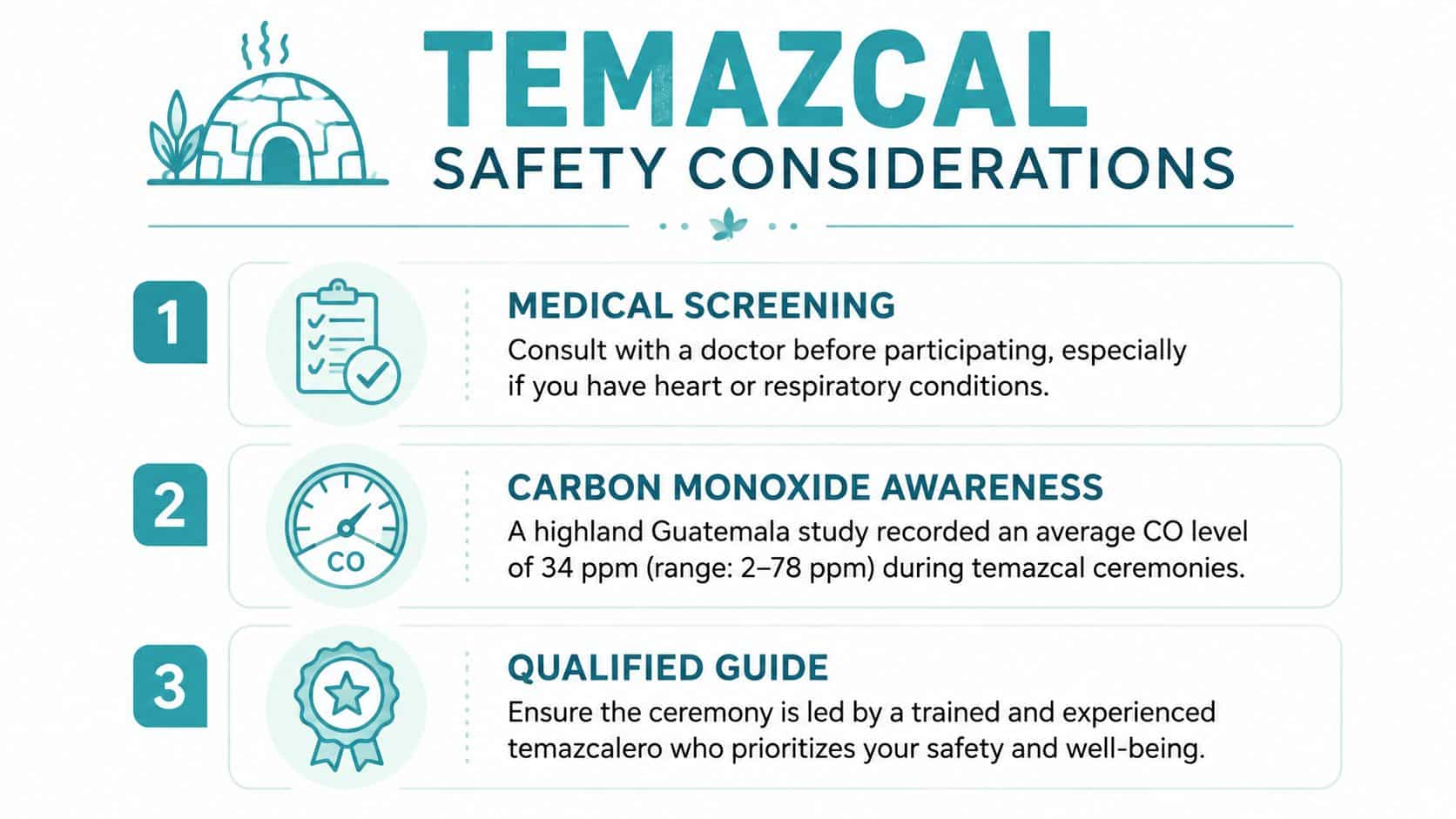
The strongest safety message is also the least glamorous. A temazcal is a high-heat exposure practice that deserves screening, supervision, and a facilitator who knows when to stop. One study in highland Guatemala reported average carbon monoxide levels inside the temazcal of 661 ± 62 ppm, with readings ranging from less than 7 ppm to more than 1,980 ppm, and average exhaled alveolar CO in adults after use of 61 ppm, ranging from 3 to 230 ppm in the published study. The authors concluded those levels were high enough to pose a risk of acute CO poisoning.
What That Means In Plain Language
Carbon monoxide is not a vague wellness concern. It’s a concrete exposure issue, especially in wood-fired versions where ventilation and fuel choice matter. The study makes one point very clear, the chamber environment itself can create a risk that has nothing to do with intention or tradition and everything to do with air quality and combustion.
That is why the most responsible facilitators treat ventilation as a safety variable, not a background detail. If a chamber is sealed too tightly, if smoke becomes heavy, or if participants start feeling off, the ceremony needs to be handled carefully.
Who Should Not Enter Without Medical Guidance
Independent Spanish-language guidance points to important contraindications, including pregnancy, serious heart or circulatory conditions, and severe mental illness as summarized in travel safety coverage. It also says participants should leave immediately if they develop dizziness, lightheadedness, nausea, chest discomfort, or breathing problems. Those are not subtle “push through it” signals.
“Safety rule: Discomfort alone is common, but symptoms that affect balance, breathing, or the chest are stop signs.”
Questions Worth Asking Before Joining
A careful participant can ask a facilitator a few direct questions before committing. Who is screening for medical conditions? Who is watching for distress during the rounds? How is the chamber ventilated? What happens if someone needs out quickly? Those questions are not rude, they’re part of informed consent.
The right mindset is neither fear nor blind trust. It’s respect for the fact that the temazcal combines heat, smoke, breath, and altered attention in a small space. That mix can be meaningful, but it also means the ceremony should be led as a disciplined practice rather than treated like a universally safe spa treatment.
How To Prepare And What To Expect
Preparation changes the experience more than many first-timers expect. A well-run temazcal begins before arrival, because hydration, food timing, clothing, and intention all shape how the body handles the heat. The goal is to enter settled, not overloaded.
Before Arrival
Light eating and good hydration usually make more sense than showing up full or dehydrated. Alcohol belongs off the table, because it adds strain to heat exposure and clouds judgment. Many participants choose natural-fiber clothing or a swimsuit, and a towel plus a change of clothes helps with the practical side of the day.
The mental side matters too. A clear intention can be simple, like rest, release, prayer, or curiosity. The point isn’t to script the ceremony in advance, it’s to know why the body is going in.
For a broader plant-medicine preparation lens, the internal guide on preparing for an Ayahuasca journey can be useful because the same basic habits, honesty, pacing, and self-awareness often support both kinds of ceremony.
During The Rounds
Arrival usually includes orientation, some version of welcome, and a reminder of how to signal if the heat gets too strong. Once inside, it helps to breathe slowly, keep track of the body, and speak up when something feels wrong. A good temazcalero will treat that as useful information, not as a failure.
First-timers often worry about claustrophobia. That reaction is understandable, because the chamber is low, dark, and intensely close. The practical answer is to communicate early, stay oriented to the guide’s voice, and remember that asking for the door to open is a normal part of the process when the body needs it.
After The Ceremony
The hours afterward matter. Water, gentle food, and rest help the body recover from heat exposure, and a short period of quiet can keep the experience from evaporating into distraction. Some people also journal afterward, not to overinterpret the ceremony, but to catch what surfaced while it’s still fresh.
A useful expectation is this. The temazcal may feel physically demanding and emotionally spare at the same time. That combination is often exactly what makes it memorable.
Pairing The Temazcal With An Ayahuasca Retreat
The temazcal often fits best as part of a larger ceremonial arc rather than as a standalone event. In retreat settings, facilitators may use it to help people arrive, settle, or close after other plant medicine work, including Ayahuasca. The practices are related in spirit, but they are not the same in how they work.
Complementary, Not Redundant
A temazcal supports purification, intention, and grounding through heat, steam, breath, and communal structure. Ayahuasca works through its own pharmacology and visionary intensity, so one doesn’t replace the other. The temazcal can help prepare the body and sharpen attention before a retreat, or it can help a participant come down gently after an intense night.
Sequencing matters. Using the temazcal on arrival may help someone unwind from travel and begin orienting to the retreat space. Using it on the final day can be a way to re-enter the body after the emotional and visual intensity of plant medicine work.
What To Ask Retreat Operators
The most useful questions are practical ones. Is the temazcal part of the retreat’s opening, closing, or both? Who leads it, and how is the guide connected to the tradition? How is intensity adjusted for people who have already done deep medicine work? Those details reveal whether the ceremony is being used thoughtfully or just added to a schedule.
Readers who want a broader framework around ceremonial leadership can also look at the internal resource on Ayahuasca shamanism, since the same questions about training, lineage, and responsibility often apply.
The most balanced approach is to see the temazcal as a preparation and integration tool that can sit beside Ayahuasca without collapsing into it. That way, each practice keeps its own character, and the retreat has room to feel coherent rather than crowded.
Finding Authentic And Ethical Experiences
The hardest question is often the most important one. Who is this ceremony for, and who benefits from it? Community-led temazcals and resort-packaged temazcals can both exist, but they do not carry the same cultural or economic logic, and the difference deserves plain attention.
How To Vet A Facilitator
A respectful participant can ask a few direct questions before booking. Who trained the temazcalero, and what lineage do they name? Is the ceremony open to visitors, or does it happen by referral inside a community context? How are medical conditions screened? Does the local Indigenous community benefit economically in a visible way?
A guide’s answers should sound specific, not performative. Vague language about “ancestral energy” is not the same as describing lineage, supervision, or reciprocity. When facilitators are clear about who they learned from and how they relate to the community, trust becomes easier to judge.
Community-Led Versus Resort-Packaged
Recent hospitality coverage shows hotel-run temazcals offered on fixed schedules, with small group caps and advance booking requirements, which signals standardization and commercialization rather than purely community-led ceremony as described in resort coverage. That does not automatically make a resort experience meaningless, but it does change the frame. The ritual is being adapted for visitors, and the adaptation should be visible to the guest.
| Dimension | Community-Led | Resort-Packaged |
|---|---|---|
| Cultural Setting | Rooted in local tradition and community context | Designed for visitor scheduling and wellness programming |
| Access | Often by relationship, invitation, or local knowledge | Usually open-booking and guest-facing |
| Leadership | Clear lineage and local authority | May be adapted for hospitality presentation |
| Economic Flow | More likely to circulate within the community | Often tied to the property’s wellness offering |
For readers looking for a practical example of how a property frames the experience, Irie Tulum Boutique Hotel temazcal tips can be read as a window into the resort style of presentation. It’s useful precisely because it shows how the ceremony can be packaged for guests, which makes it easier to compare with a community-led setting.
“Treat the temazcal as a borrowed practice, not a consumable.”
That mindset changes the booking decision. It pushes the reader to consider reciprocity, compensation, and cultural humility, not just ambience and convenience. A respectful-practices checklist is simple enough to keep in mind anywhere, ask who leads, ask who benefits, ask how safety is handled, and ask whether the setting honors the lineage instead of smoothing it away.
A temazcal can be powerful, grounding, and culturally rich when it is entered with care. The best next step is to choose a setting that can answer direct questions clearly, then prepare with the same seriousness the tradition itself asks for, and explore more educational resources at Ayahuasca.com before committing to any ceremony.
Disclaimer: The information provided on Ayahuasca.com is for educational purposes only and is not intended as medical advice, diagnosis, or treatment. Ayahuasca is a powerful traditional Amazonian medicine and may not be suitable for everyone. Always consult with a qualified healthcare professional before making decisions related to health, mental well-being, medications, or the use of Ayahuasca.