
You may be sitting with two browser tabs open right now. One has a beautiful retreat website with jungle photos, soft lighting, and words like healing, transformation, and safety. The other has a much less comforting set of questions. Is this legal. Who is qualified. What happens if I have a medical issue. How do I know whether a center is grounded in real practice or polished marketing.
That tension is healthy.
The desire to attend an Ayahuasca ceremony Costa Rica often begins as a quiet inner pull, but a wise first step is not surrender. It is discernment. Costa Rica can offer a more accessible path than remote Amazonian travel, yet that convenience also creates a crowded environment where excellent centers and weak operators can appear similar from the outside.
If you are new to this, the most useful mindset is simple. Stay open-hearted and hard to impress.
A strong center will welcome informed questions. It will explain its medical screening, facilitator training, ceremonial structure, and integration support without getting evasive or defensive. A weaker center will lean on mystical language, social proof, and urgency.
Ayahuasca deserves reverence. Your nervous system deserves protection. Both matter.
Answering the Call to Ayahuasca in Costa Rica
People usually arrive at this search for one of three reasons. Pain. Curiosity. Or a long-standing spiritual pull that has finally become difficult to ignore.
Sometimes it follows grief, burnout, addiction, anxiety, or the sense that old therapeutic tools have helped, but only to a point. Sometimes the call is less dramatic. Life looks functional from the outside, but inwardly something feels unfinished, disconnected, or numb.
That inner movement matters, but so does timing.
Ask what is calling you
Before you compare retreat centers, get honest about your reason for going. A clear intention will help you choose the right environment.
A few examples:
- Trauma work: You may need a center with stronger therapeutic support and careful screening.
- Spiritual inquiry: You may prefer a more traditional ceremonial container with less extra programming.
- Life transition: You may benefit from thorough post-retreat integration rather than a luxury-heavy experience.
Write your reason in one sentence. Not your ideal result. Your real reason.
“Something in me needs to face what I have been avoiding” is more useful than “I want transformation.”
Respect the difference between readiness and urgency
Ayahuasca is not a race. A good retreat next season is better than a rushed booking next month.
Readiness usually includes:
- stable enough mental health to tolerate intensity
- willingness to disclose medications and diagnoses forthrightly
- capacity to follow preparation guidelines
- openness to discomfort without demanding control of every moment
Urgency often sounds different:
- “I need this to fix me now”
- “I do not want to tell them about my meds”
- “I will just figure out the legal part later”
- “The website feels right, so I am booking”
“Practical rule: If you feel rushed, slow down. Good decisions around Ayahuasca usually improve when you give them a few extra days.”
Let skepticism work in your favor
Costa Rica attracts many first-timers because travel is easier, accommodations are often more familiar, and the wellness culture feels approachable. Those can all be benefits. They can also make it easier to confuse comfort with competence.
The safest way forward is to treat this path like both a spiritual journey and a serious health decision. You do not need fear. You do need standards.
Understanding Ayahuasca and Its Place in Costa Rica
You land in Costa Rica, the air feels soft, the retreat photos look beautiful, and the whole trip suddenly feels more real than it did on your laptop. This is usually the moment first-timers realize two things at once. Ayahuasca is not a spa treatment, and Costa Rica is not a simple container for it.
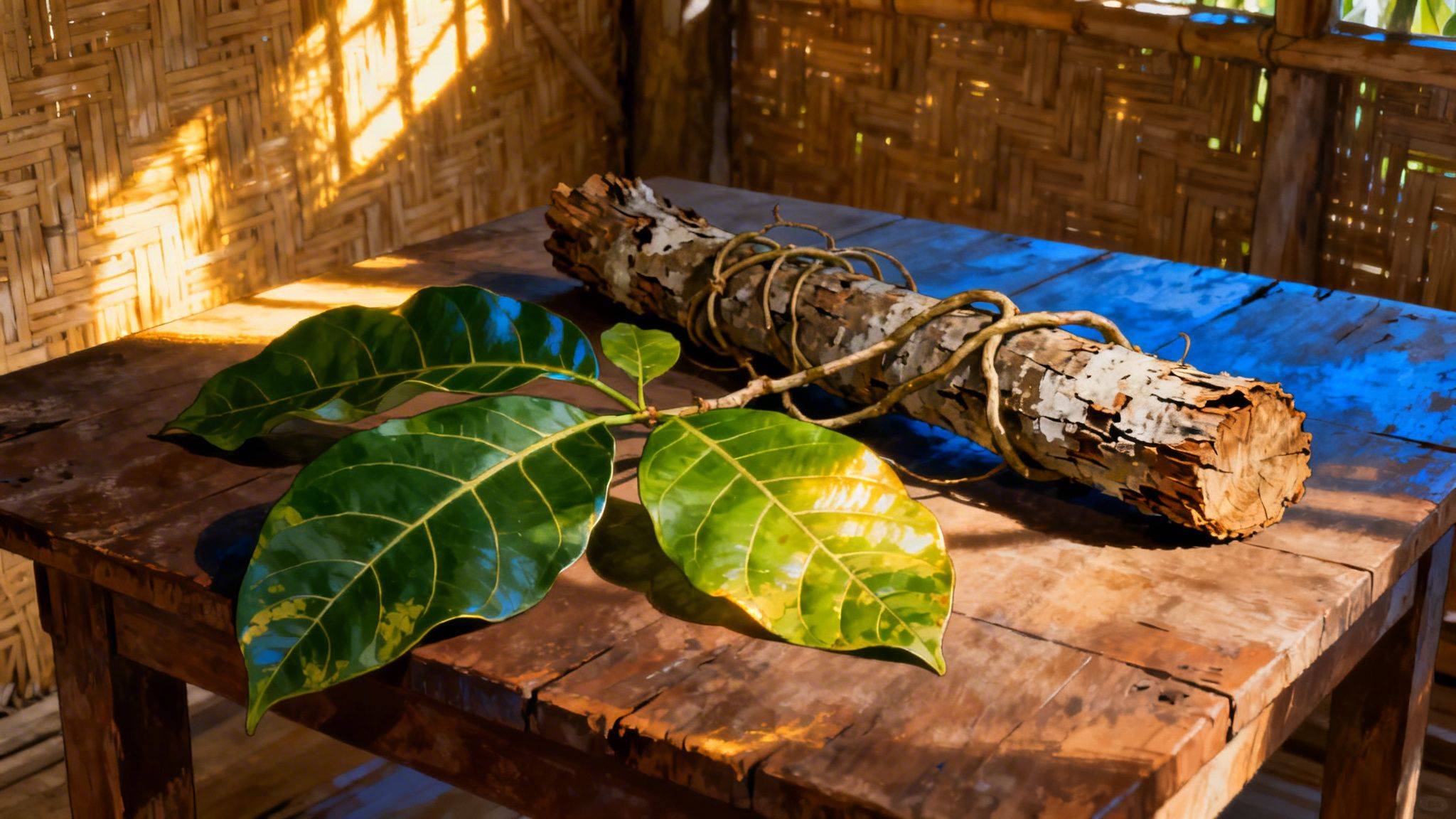
Ayahuasca is a traditional plant medicine brew associated with Amazonian lineages. It is commonly made from Banisteriopsis caapi and Psychotria viridis. The chemistry matters because it helps explain why medication screening, diet guidance, and facilitator competence are safety issues, not administrative details.
In ceremony, though, people do not work with Ayahuasca as chemistry alone. It is treated as medicine within a ritual setting shaped by intention, music, structure, and the skill of the people holding the room. That cultural and ceremonial context is a key part of the experience, especially for guests coming from outside the traditions where this work began.
Why Costa Rica became a major destination
Costa Rica draws many first-time guests because it is easier to reach than remote parts of the Amazon, and the travel experience usually feels less intimidating. Retreat centers often offer comfortable lodging, airport support, good food, and a level of hospitality that helps people arrive less stressed and more willing to do serious inner work.
That accessibility has a downside.
A polished retreat in Costa Rica can feel trustworthy long before you know whether the center screens medications carefully, has experienced ceremonial leadership, or can respond well when a guest becomes overwhelmed. Comfort helps. It does not prove competence. If you are comparing options, it also helps to understand how much an ayahuasca retreat usually costs, because price can reflect staffing, setting, and support level, but it still does not confirm quality.
DoubleBlind’s reporting on Ayahuasca in Costa Rica describes why the country has become such a visible destination for this work. The same visibility is part of the challenge. More demand attracts excellent centers and weak ones at the same time.
The legal gray area is real
Costa Rica’s situation around Ayahuasca is not neatly defined. DoubleBlind reports official warnings from the Ministry of Health in 2022 and 2025 related to unregulated use and promotion, and describes a legal situation where personal possession is decriminalized while paid ceremonies sit in a much more complicated category.
For guests, the practical takeaway is simple. Do not assume words like “legal,” “licensed,” “authorized,” or “approved” all mean the same thing.
Ask what a center is legally registered to do. Ask whether the retreat property, lodging operation, health services, and ceremonial activities are being described separately or blurred together in marketing copy. A center can operate openly and still be vague about what protections exist for guests. Legal ambiguity affects real-world decisions. It can shape how centers advertise, how transparent they are in writing, what kind of emergency planning they put in place, and how candidly they answer hard questions before you book.
What this means for your decision
A careful center usually speaks plainly. It does not promise miracle healing, imply that Ayahuasca is safe for everyone, or hide behind mystical language when you ask practical questions. In my experience, the best operators in Costa Rica respect both sides of this work. They honor the ceremony, and they handle screening, consent, and guest care with discipline.
A weaker center often sounds impressive but stays vague where specifics matter.
Use a simple filter:
| Question | Why it matters |
|---|---|
| What exactly is the center licensed for | A business registration can cover lodging or tourism without clarifying ceremonial activities |
| Who reviews medical forms and medication disclosures | Good screening requires judgment, not just data collection |
| Who leads the ceremony and who supports the room | Safety depends on experience, ratio, and role clarity |
| What happens if a guest has a severe psychological or physical reaction | You need a concrete protocol |
| What support exists after the ceremony and after you return home | Intense experiences can stay open long after the trip ends |
Costa Rica can be a wise place to begin. It can also be a place where branding hides weak standards. Treat the setting as one factor, not proof. The central question is whether the center can care for people well when the night stops being beautiful and starts being difficult.
How to Choose a Safe and Authentic Ayahuasca Center
A first-time guest often starts with the wrong signals. The photos look serene. The testimonials sound profound. The website speaks about healing, lineage, and love. Then you ask what happens if someone has a panic response at 2 a.m., who reviews SSRI use before arrival, or how the center handles Costa Rica’s legal gray area, and the answers get thin.
That is the point where marketing stops and real standards begin.
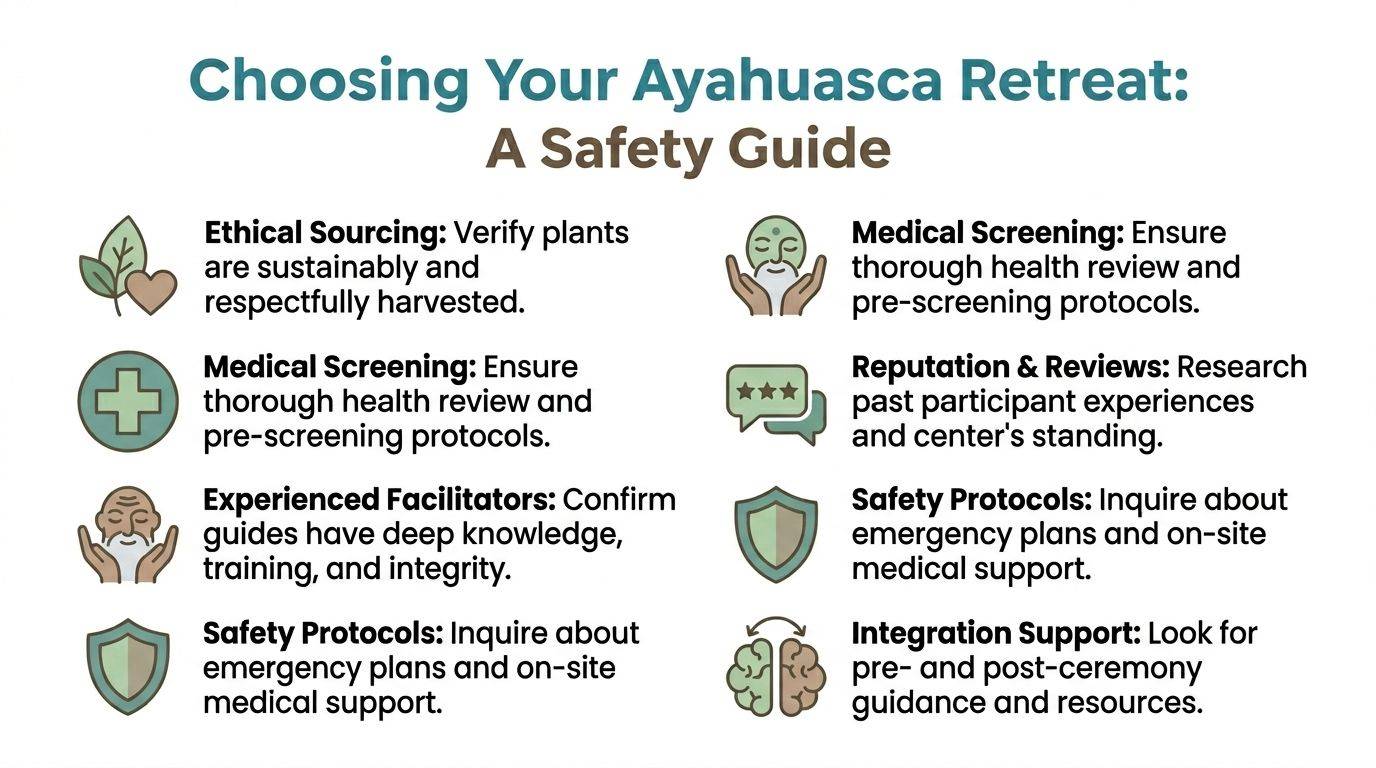
Costa Rica attracts sincere facilitators and polished retreat businesses. It also attracts operators who know how to sell an experience. Since ayahuasca does not sit inside a simple, clearly regulated framework there, you cannot assume a beautiful center has meaningful oversight. You have to verify how the work is conducted, who is responsible for guest care, and what the center can do if a ceremony becomes difficult.
Ask how the center operates, not just what it believes
Start with the legal and operational basics.
A trustworthy center should be able to explain what the business is registered as, who owns or manages the property, who is responsible for ceremonies, and how they describe their work to guests without hiding behind vague language. You are not looking for a legal lecture. You are listening for honesty, clarity, and consistency.
If a center becomes evasive when you ask practical questions, treat that as useful information.
Then ask about the ceremonial leader in plain terms:
- Who trained them
- Which tradition or traditions shaped their practice
- How many years they have been serving in ceremony
- Whether they personally lead each night or rotate in other staff
- What happens if the primary facilitator is sick, absent, or replaced at the last minute
Specific answers matter more than polished spiritual language. “I trained with X family in Peru for Y years and I lead all ceremonies with the same support team” tells you something. “Our facilitators are called to the medicine” tells you almost nothing.
Screening is where serious centers separate themselves
The intake process should feel careful.
A good center asks about medications, psychiatric history, heart issues, blood pressure concerns, substance use, trauma history, and recent instability. It follows up when something is unclear. It may ask you to get medical clearance. It may tell you to wait.
That is not rejection. That is care.
Be wary of centers that accept everyone quickly, especially if they frame the dieta as a symbolic extra or treat medication disclosure casually. Preparation has practical consequences. Food restrictions, substance restrictions, and medication review are there to reduce avoidable risk, not to make the retreat feel more spiritual.
Look for safety systems you can picture clearly
Ask questions that force concrete answers.
A well-run center can explain the room setup, the facilitator-to-guest ratio, who stays sober and alert throughout the night, where guests go if they need quiet support, and how transportation to outside medical care would work if needed. They should also be able to explain how they respond to dissociation, severe fear, confusion, or physically unsafe behavior.
I pay close attention to one thing here. Can the center describe its protocol without sounding defensive or rehearsed? Experienced teams usually answer calmly because they have had to care for people through hard nights before.
Use this checklist:
| What to ask | Why it matters |
|---|---|
| Who reviews health forms and medication disclosures | Safety depends on informed screening, not automated intake |
| Who is physically present during ceremony | You need role clarity, sober support, and enough staff in the room |
| What happens if a guest wants to stop or refuses a second cup | Consent should remain active throughout the retreat |
| How do you handle acute panic, disorientation, or aggression | A real protocol is more useful than general reassurance |
| Is there transport available for outside care | Distance and response time matter in rural Costa Rica |
| What support is offered after ceremony and after the retreat | Difficult material often surfaces after the peak experience |
Match the center to the kind of support you need
Many first-timers choose the center that feels most inspiring. A better approach is to choose the center whose structure fits your history.
Traditional settings can offer ritual depth, strong ceremonial focus, and continuity of practice. They can also expect more self-reliance. Hybrid centers often provide stronger preparation calls, psychological framing, body-based support, and integration help. That can be a better fit for someone new to altered states, someone with a trauma history, or someone who wants clearer explanation before and after ceremony. Luxury-focused retreats may offer comfort and privacy, but comfort alone does not tell you whether the ceremonial container is sound.
There is a trade-off in every model. More ritual purity does not always mean more interpersonal support. More therapeutic structure does not always mean deeper ceremonial skill. The right question is not which style sounds best. It is which one can hold you well.
Price should prompt better questions
Retreat pricing in Costa Rica varies widely. Sometimes the higher cost reflects experienced staff, lower guest numbers, stronger food and lodging, private integration support, and better logistics. Sometimes it reflects branding.
Lower-cost retreats are not automatically careless. Higher-cost retreats are not automatically safer.
Use price as a prompt to ask what is included, what staff are paid to do, how many guests share one team, and whether preparation and aftercare are built into the retreat. If you are comparing options, this guide to how much an Ayahuasca retreat can cost gives a useful frame for evaluating value beyond aesthetics.
Reviews help, but patterns help more
Read reviews for operational details. Look for mentions of clear screening, honest communication, respectful boundaries, reliable support during difficult moments, and thoughtful integration after the retreat. Those details carry more weight than glowing language about the property or the food.
One revealing question to ask any center is this: “Who is not a good fit for your retreat?”
Mature centers answer directly. They know this work is meaningful, powerful, and not appropriate for everyone at every moment. A center that cannot name limits usually has weak ones.
The Ayahuasca Ceremony What to Expect Step by Step
Most first-time fear comes from not knowing the sequence. Once you understand the arc of a ceremony, the experience becomes less mysterious and more workable.
That does not make it easy. It does make it easier to meet.
Before the first cup
Preparation starts before ceremony night. In Costa Rican retreat settings, the dieta usually includes avoiding red meat, processed foods, alcohol, caffeine, sex, and stimulants for a period leading into the retreat, as described in the verified 1Heart material linked earlier.
In practical terms, this does three things.
It reduces physiological friction. It steadies the mind. It signals respect.
Guests who treat preparation casually often arrive physically overstimulated and psychologically scattered. Guests who follow the dieta with care usually enter the space more receptive and less resistant.
Pack light for ceremony. Comfortable layers. A blanket if the center allows it. A journal for afterward, not during. The verified Temple of the Way of Light guide also mentions practical items such as red-light flashlights, blankets, and silence protocols as part of a well-held ceremonial environment through their Ayahuasca ceremony guide.
Entering the ceremonial space
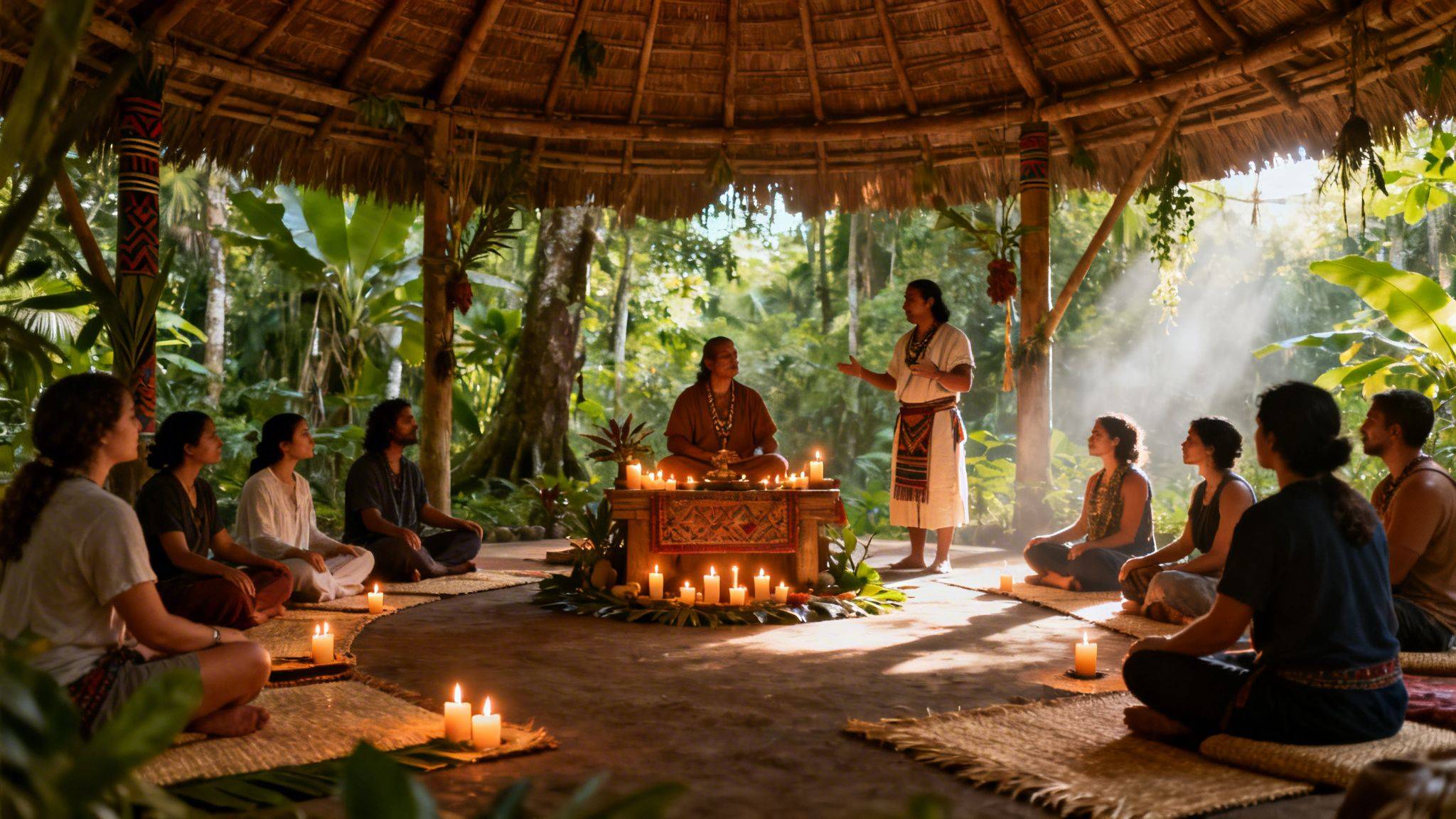
The room may be called a maloka or the ceremony space. However it is named, the shift usually becomes obvious the moment people enter. Conversation drops. Attention narrows. The atmosphere becomes deliberate.
You will likely be shown where to sit, where your bucket is, where the restroom is, and how to ask for help if needed.
This also shows many first-timers something helpful. Ceremony is not random. In well-run settings, there is rhythm, pacing, and structure.
Drinking and waiting
After intention-setting and opening prayers or songs, the medicine is served. The waiting period can feel long or very short depending on your state.
The onset is sometimes referred to as mareación, and the verified Temple guide describes this as the initial phase that can include nausea and disorientation. That early period is often uncomfortable because your ordinary orientation starts loosening before any insight arrives.
At this stage, beginners often make their first mistake. They start evaluating too soon.
You may think:
- nothing is happening
- too much is happening
- I made a mistake
- I need this to stop
- everyone else is doing better than I am
All of that can occur before the deeper work has even begun.
“Ceremony tip: Do not grade your night while you are still in it. Stay with breath, posture, and the next minute.”
The role of dosage and guidance
In vetted ceremonies, dosages are progressively adjusted across sessions, rather than handled as a one-size-fits-all event, according to the verified Temple material. That detail matters because sensitivity varies widely between participants.
The same source notes that healers use icaros and soplar to guide the experience. If you are new to these terms, think of them as active ceremonial interventions, not decoration. Icaros are sacred songs used to direct, soothe, and shape the field of the ceremony. Soplar involves targeted energetic cleansing with tobacco smoke.
In experienced hands, those elements can change the emotional feel of a difficult passage. A guest may move from panic to release, or from mental spinning to embodied grief, not because someone talked them out of it but because the ceremonial support shifted the space skillfully.
Later in your research, it can help to read a fuller description of the Ayahuasca experience and what to expect, especially if you want a broader map of common effects.
A short visual overview can help some readers orient before they arrive:
The purge and the return
Purging can include vomiting, crying, shaking, sweating, or intense emotional release. Some people purge a lot. Some barely at all. Neither outcome proves more spiritual merit.
What matters is whether the center frames purge responsibly. It can be meaningful. It can also be physically demanding. Good support includes hydration guidance, observation, and calm reassurance without forcing interpretation.
As the ceremony softens, many guests pass through a quiet reflective period. The room feels less charged. The body begins to settle. Fatigue often arrives.
The verified Temple material also cites evidence from over 32,000 ceremonies at centers like Rythmia and reports 98% of guests describing life-changing “miracles,” linked to personalized and medically supervised protocols in that source. Take that as one center-specific data point, not a guarantee of your own outcome. The better lesson is that structured dosing and support appear to matter.
A good ceremony does not have to be pleasant from start to finish. It has to be held well.
Integrating Your Experience for Lasting Transformation
The ceremony ends long before the work does.
Many people return from Costa Rica with genuine insight and then lose momentum because daily life rushes back in. Email, family roles, deadlines, old habits, unresolved relationships. If insight is not translated into action, the experience can fade into memory rather than become change.

Why integration deserves more scrutiny
This is one of the weakest areas in the market.
Many retreats mention integration circles, but there is a lack of quantitative data on long-term efficacy. The verified BookRetreats material notes that Rythmia claims 93.42% of guests report lasting benefits after six months, while also highlighting a wider industry gap in comparative data through BookRetreats’ Costa Rica Ayahuasca listings. That gap matters because it means you often have to evaluate integration by quality of structure rather than broad independent benchmarks.
A retreat that talks endlessly about ceremony but says little about the weeks afterward is incomplete.
What effective integration looks like
Strong integration is specific. It gives you containers, not just encouragement.
Useful post-retreat supports include:
- Journaling prompts: write down key images, bodily sensations, unresolved questions, and any direct instructions you felt
- Nature and quiet: keep sensory load low for a few days if possible
- Body-based practices: walking, breathwork, yoga, stretching, and sleep discipline help settle the nervous system
- Relational care: choose carefully who you share with in the first week
- Professional support: if your process touches trauma, addiction, or severe anxiety, skilled therapeutic support can be very helpful
One of the most grounded ways to work with post-ceremony material is to turn insight into one behavior change. Not ten. One.
If the medicine showed you chronic self-abandonment, your first act may be a boundary. If it showed you grief, your first act may be making time to feel rather than distracting yourself. If it showed you exhaustion, your first act may be rest.
Questions to ask a retreat before booking
Use these to evaluate whether integration is real or ornamental:
| Question | Good sign |
|---|---|
| How long does support continue after the retreat | The center names a clear timeframe and format |
| Who leads integration | You get real roles, not vague “community support” |
| Is support individual, group-based, or both | The answer matches your needs |
| What happens if a guest feels destabilized afterward | The center has a protocol and referral pathway |
“Best practice: Do not assume a moving ceremony automatically becomes a lasting transformation. Integration is the bridge.”
If you want a broader perspective on how inner insight becomes real-world change, this exploration of Ayahuasca and transformation is a helpful companion read.
Planning Your Trip Logistics and Resources
A spiritual decision still needs good travel planning.
The more practical details you handle early, the easier it becomes to arrive regulated, rested, and focused. Most avoidable stress around an Ayahuasca ceremony Costa Rica happens before the first ceremony begins.
Choose your airport based on retreat location
Costa Rica’s two main international gateways for retreat travel are SJO and LIR. The right airport depends on where your center is located.
A simple rule helps:
- SJO: often more practical for retreats closer to the Central Valley and some inland areas
- LIR: often more practical for Guanacaste, Tamarindo, and nearby Pacific regions
Ask the retreat directly which airport they recommend and whether they provide transfers. Do not guess based on a map alone. Road times can be longer than they appear.
Pack for simplicity, not for style
Your retreat wardrobe should support rest, temperature changes, and emotional ease.
A useful packing list includes:
- Loose clothing: easy to wear when bloated, tired, or temperature-sensitive
- Light layers: nights can feel cooler than expected
- Slip-on shoes or sandals: practical for bathroom trips and wet ground
- Journal and pen: for integration notes after ceremony
- Reusable water bottle: if the center recommends one
- Toiletries kept simple: avoid strong fragrances
- Travel folder: passport, insurance details, transfer information, emergency contacts
For ceremony itself, follow the center’s guidance first. Some provide nearly everything you need. Others expect you to bring a few personal comfort items.
Budget with the full trip in mind
Retreat cost is only one part of the expense.
The verified data provided for this article notes Costa Rica retreat prices in a broad range depending on center type and support level. In practice, your total budget may also include flights, airport transfers, extra nights before or after the retreat, travel insurance, and any integration support you choose once you return home.
A cheaper retreat can become expensive if logistics are chaotic or support is thin. A more expensive retreat can still be poor value if it prioritizes amenities over screening and care.
Responsible travel matters
In 2019, approximately 62,000 Ayahuasca tourists traveled to the Amazon region and Costa Rica, while global consumption was estimated at 5.5 million servings in that same year, according to ICEERS reporting on Ayahuasca tourism and use. That contrast is worth sitting with.
Retreat tourism is visible, but it is still only a small slice of the larger Ayahuasca world. The medicine does not exist for tourism. It comes from living traditions, communities, and ecosystems that deserve respect.
That has practical implications:
- choose centers that speak respectfully about lineage
- avoid consumer language that treats ceremony like entertainment
- follow center rules carefully
- do not pressure facilitators for extra access, exceptions, or personalized special treatment
A final pre-booking checklist
Before sending a deposit, make sure you can answer yes to most of these:
- I understand the center’s screening process
- I know who leads ceremony and what their background is
- I have reviewed the preparation guidelines
- I know how arrival and airport transfer work
- I know what post-retreat integration support exists
- I am not hiding medications, diagnoses, or recent instability
- I would still choose this center even without the marketing photos
That last one matters more than people think.
If you want a trusted next step, explore the educational resources and vetted retreat guidance at Ayahuasca.com. The right retreat should feel clear before it feels exciting.
Disclaimer: The information provided on Ayahuasca.com is for educational purposes only and is not intended as medical advice, diagnosis, or treatment. Ayahuasca is a powerful traditional Amazonian medicine and may not be suitable for everyone. Always consult with a qualified healthcare professional before making decisions related to health, mental well-being, medications, or the use of Ayahuasca.