
Somewhere in the last few days, you may have opened a dozen tabs and typed the same question in slightly different ways.
Where can you get Ayahuasca. Is it legal in Peru. Are there safe retreats in Costa Rica. Can you find a ceremony closer to home. How do you know who to trust.
That kind of searching usually means something deeper is happening. You are not just planning a trip. You are trying to make sense of a powerful decision that touches your body, your mind, your beliefs, and your safety.
A lot of people start with geography. They ask for a country, a retreat list, or a church name. Geography matters, but it is not the most important part. Two ceremonies in the same town can feel completely different. One may be careful, grounded, and well-held. The other may be chaotic, manipulative, or medically irresponsible.
So when people ask where can you get ayahuasca, the wiser question is this: In what kind of setting, with whom, under what legal conditions, and with what safety standards?
That shift changes everything.
The Starting Point of Your Ayahuasca Journey
Many first-time seekers arrive at Ayahuasca through a very ordinary moment. A friend mentions a retreat. A podcast guest talks about healing. A difficult life season pushes someone to look beyond the tools they already know. Then the search begins.
At first, the question seems simple. Find a place. Book a flight. Show up.
But Ayahuasca does not work like buying a ticket to a workshop or reserving a hotel. The ceremony is shaped by the container around it. By container, I mean the whole environment: the facilitators, screening process, legal setting, emergency readiness, group culture, and what happens after the ceremony ends.
Why the question of where gets confusing
Ayahuasca has moved far beyond its Amazonian roots. An ICEERS report estimates that 4,239,540 people worldwide have taken Ayahuasca at some time in their lives, with 90% representing modern, global seekers, and the United States leading in absolute numbers with approximately 1.5 million people having tried Ayahuasca (ICEERS global use report).
That global spread creates both opportunity and confusion.
You can now find Ayahuasca-related offerings connected to jungle retreat centers, Brazilian churches, private facilitators, wellness spaces, and underground circles in Western cities. Some are rooted in lineage and ethics. Some are polished on the surface and weak underneath.
The map is not the territory
A country can be permissive, and a provider in that country can still be unsafe.
A center can use beautiful language about healing and still skip medical screening. A facilitator can talk about tradition and still have no meaningful accountability. A website can look serene while hiding poor boundaries, unclear emergency plans, or pressure-based sales.
“Key takeaway: The fundamental answer to where can you get Ayahuasca starts with evaluating the people and the structure around the ceremony, not just the location pin on a map.”
Some readers feel relieved when they hear that. It means you do not need to chase a fantasy version of the “perfect” country. You need to learn how to recognize a setting that respects the medicine, the traditions behind it, and your well-being.
A more grounded way to begin
Start by asking yourself a few direct questions:
- What am I seeking: healing support, spiritual exploration, clarity, grief work, or curiosity.
- What kind of environment helps me feel safe: formal and structured, traditional and simple, or therapeutic and modern.
- Do I need medical oversight or mental health support: especially if you take medications or have a complex history.
- Am I willing to slow down: careful preparation matters more than fast access.
That is the starting point. Not urgency. Not romantic ideas about the jungle. Not fear of missing a rare chance.
A good Ayahuasca decision usually feels less like chasing and more like careful listening.
Understanding The Three Worlds of Ayahuasca
If the context around Ayahuasca feels messy, it helps to sort it into three worlds. Think of them as three different vessels carrying people toward similar waters, each with its own strengths, limits, and risks.

Traditional Indigenous ceremonies
This is the world many people picture first.
These ceremonies are rooted in ancestral lineages from the Amazon, often led by indigenous healers or people trained closely within those traditions. The ceremony may be woven into a larger worldview that includes plant diets, prayer, songs, community relationships, and years of apprenticeship.
For some seekers, this setting feels most aligned with reverence and cultural depth. It can offer a sense that Ayahuasca is being held within the context that gave birth to it.
That said, tradition alone does not guarantee safety. A center can advertise indigenous connection while operating mainly for tourists. It is worth asking who leads the work, who benefits financially, how participants are screened, and whether cultural language is being used as decoration or as real practice.
Syncretic religious churches
The second world includes structured religious settings such as Santo Daime and União do Vegetal (UDV).
These spaces are usually more formal than retreat culture. They often have liturgy, shared doctrine, established community roles, and repeated ceremonial forms. For some people, this feels reassuring. There is less mystery about how the ceremony is held. The container may be more standardized, and the community may extend beyond a one-time retreat.
This world is often a better fit for people who want an ongoing spiritual framework rather than a single intense experience packaged as transformation. It can also feel less consumer-oriented.
The tradeoff is that the religious dimension may not suit everyone. If you want a less doctrinal environment, church settings may feel unfamiliar or restrictive.
Modern retreats and urban circles
The third world is the broadest. It includes jungle retreat centers built for international guests, therapeutic-style retreat programs, private facilitators, and underground ceremonies in cities.
Much confusion arises here, because quality varies enormously.
Some modern centers are thoughtful, trauma-informed, well-screened, and ethically run. Others are loose, personality-driven, or poorly equipped for the intensity of the experience. Urban circles can be more accessible, but they often come with less oversight and weaker accountability.
One of the clearest warnings comes from reporting on unregulated circles. A 2024 Psychedelic Alpha survey of 2,500 users found that 30% of participants reported “sexual misconduct” incidents in unregulated US circles, compared to less than 5% at established Shipibo-led centers (Temple of the Way of Light article citing the survey).
That statistic points to something many newcomers miss. The biggest risk is often not the map location. It is the human container around the experience.
“Tip: If a provider emphasizes mystique more than screening, boundaries, consent, and aftercare, pause. A safe container should be able to explain its practical safeguards clearly.”
A fourth path people ask about
Some people skip all three worlds and wonder about brewing Ayahuasca themselves at home.
I strongly discourage that.
Home brewing can sound simple when discussed online, but it removes the very things that matter most: skilled support, medical screening, supervision during a vulnerable state, and help with integration afterward. It also raises legal risks, especially around sourcing or transporting restricted ingredients.
Ayahuasca is not like trying a wellness supplement in your kitchen. A better analogy is open-water swimming. The water itself may be meaningful and beautiful, but currents matter, weather matters, and who is watching from shore matters.
Which world fits you
There is no universal best setting.
A person seeking cultural depth may lean toward an indigenous-led retreat with clear ethics and transparency. Someone who values ritual structure might feel more at home in a church. Another person may prefer a modern center with medical intake, integration calls, and smaller groups.
What matters is matching your needs with a setting that can support them. That is the core work behind asking where can you get ayahuasca.
A Global Map of Ayahuasca Retreats and Regions
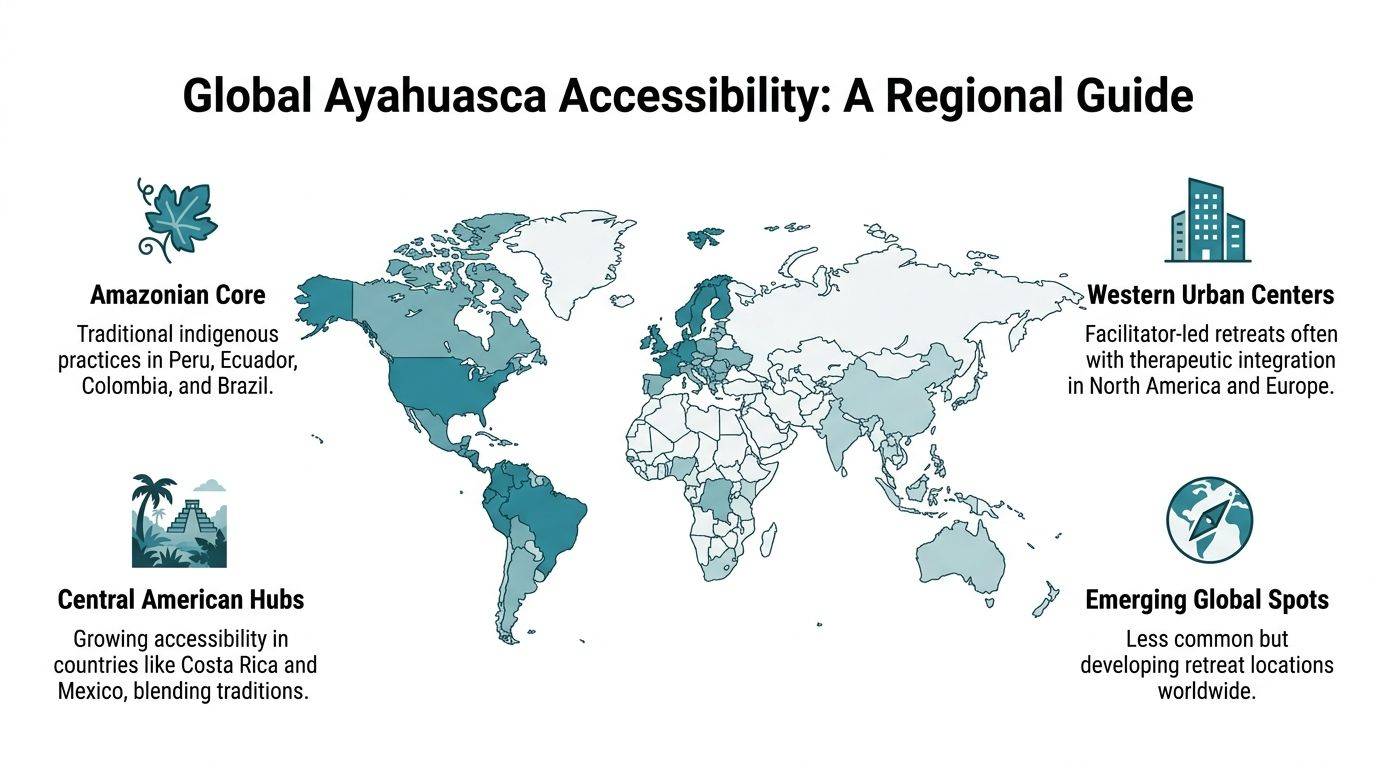
The geography of Ayahuasca access is wider than many people expect. Still, a few regions come up again and again because they combine tradition, established retreat culture, religious use, or a more permissive legal environment.
Peru
Peru is one of the best-known destinations for Ayahuasca travel. Many seekers are drawn there because of its strong association with Amazonian healing traditions and the large number of retreat centers serving international guests.
That visibility has a double edge.
Peru also appears prominently in media-reported harm data. Peru accounts for 30% of all 58 documented Ayahuasca-related deaths reported in media, or 17 cases, primarily linked to tourist retreat centers between 2010 and 2019 (ICEERS analysis of media-reported deaths). That does not mean Peru is unsafe. It means tourism volume and weak vetting can create serious problems when people choose poorly.
Peru can offer meaningful work. It also demands discernment.
Brazil
Brazil stands apart because its Ayahuasca ecosystem includes a long-established regulated religious framework.
According to the same ICEERS-linked material, Brazil hosts the world’s largest regulated Ayahuasca ecosystem through CONAD Resolution 5/2004, permitting religious use by over 20,000 members annually with mandated brew consistency (same ICEERS deaths report reference).
That matters because regulation changes the shape of access. In Brazil, many seekers encounter Ayahuasca through churches and organized religious communities rather than tourism-driven retreat settings. For some people, that provides a steadier structure. For others, the religious frame may feel too specific.
Colombia
Colombia is often less discussed in mainstream retreat lists, but it holds a significant place in the broader Ayahuasca context because of its deep indigenous traditions and notable prevalence. In the verified data, Colombia shows a notable prevalence rate among studied countries, reflecting its strong traditional roots and institutional support. I am not repeating the source link here because it was cited earlier, but that context matters when thinking about where Ayahuasca is woven into living culture rather than positioned mainly as a retreat product.
For the traveler, Colombia can appeal to those seeking a setting that still feels close to traditional use. The same caution applies as anywhere else: verify the provider, not just the country story.
Ecuador
Ecuador is often grouped with the Amazonian core, and many seekers encounter it through smaller retreat programs, healing lodges, or referrals from experienced travelers. It is commonly seen as a place where indigenous knowledge and retreat infrastructure overlap.
What makes Ecuador tricky is not lack of interest. It is the wide range of provider quality. Some centers are intimate and careful. Others may be thin on screening, vague about leadership, or heavy on marketing language. In practice, Ecuador often requires the same kind of careful vetting that Peru does, though the scene may feel less saturated.
Mexico and Costa Rica
These two countries often appear in searches from North American travelers who want a shorter flight, a more familiar hospitality style, or a retreat setting outside the Amazon.
In the verified data, Mexico stands out as fully legal for Ayahuasca retreats, although enforcement around imports remains a separate issue, and Costa Rica decriminalizes personal use but imposes severe penalties for sale or ceremonies under trafficking laws. The legal lesson is simple. A place can look easy from a traveler’s point of view while still containing legal complexity beneath the surface.
This is one reason I encourage people not to rely on social media confidence or retreat marketing when assessing legality.
Europe and the United States
You may also be wondering if the answer to where can you get ayahuasca could be closer to home.
Sometimes yes, but the quality range becomes even wider. In Europe and the United States, access may appear through churches, private invitation circles, facilitator-led retreats, or underground groups. The convenience can be appealing. The accountability can be inconsistent.
If you stay local, the burden of vetting grows. You need more than a polished website or a glowing testimonial.
Comparing Ayahuasca Retreat Destinations
| Country | Legal Status | Primary Context | Key Consideration |
|---|---|---|---|
| Peru | Progressive framework commonly associated with retreat access | Retreat centers and traditional-influenced tourism | Strong traditions, but careful provider screening is essential |
| Brazil | Regulated religious use under CONAD framework | Santo Daime, UDV, and related religious communities | Structured ecosystem may suit seekers comfortable with church settings |
| Colombia | Access shaped by indigenous and cultural context | Traditional and locally rooted ceremonial settings | Deep cultural roots, but provider vetting still matters |
| Ecuador | Mixed and variable depending on provider context | Retreat centers and indigenous-connected offerings | Quality varies widely from center to center |
| Mexico | Fully legal in verified data context | Private retreats and nonprofit or company-run offerings | Legal openness does not remove the need for screening and import caution |
| Costa Rica | Personal use decriminalized, ceremonial sale carries legal risk | Retreat tourism | Attractive for travelers, but legal nuance is easy to misunderstand |
| United States | Highly context-dependent | Churches, private circles, underground gatherings | Accessibility can hide weak oversight |
| Spain and Netherlands | European hubs in the broader global scene | Community and retreat-based access | Normalization does not equal uniform safety |
“Key takeaway: Countries create the outer frame. Providers create the lived experience. A wise choice depends on both.”
Your Vetting Checklist How to Choose a Safe Provider
Your decision becomes concrete here.
A retreat website may show jungle paths, candles, smiling staff, and language about healing. None of that tells you whether the provider knows how to screen participants, respond to crisis, maintain boundaries, or support integration after difficult ceremonies.
Start with transparency
A trustworthy provider can answer direct questions without getting defensive or vague.
Ask who leads the ceremonies. Ask what training they have. Ask how long they have been serving in this context. Ask whether they work with medical advisors, facilitators, bodyworkers, or integration staff. If the answers are slippery, overly mystical, or centered on charisma, pay attention.
A solid provider should also explain cost clearly. If you are trying to understand pricing ranges and what retreat fees usually include, this guide on how much an Ayahuasca retreat costs can help you compare what different programs bundle into the experience.
Ask the questions many people avoid
Here are the questions I would consider basic, not optional:
- Medical screening: Do you require a health questionnaire before acceptance?
- Medication review: How do you handle antidepressants, stimulants, sleep medications, and other potential contraindications?
- Mental health history: What conditions would make participation unsafe or inappropriate?
- Emergency plan: What happens if someone has a medical crisis or severe psychological distress?
- Consent and touch policy: Are assistants allowed to touch participants, and under what conditions?
- Sleeping arrangements: Do guests have privacy and physical security?
- Group size: How many participants attend each ceremony, and how many staff are present?
- Aftercare: What support exists after the retreat ends?
When people feel embarrassed asking these things, I remind them of something simple. Good providers want informed participants. Only weak providers rely on your hesitation.
Look for evidence of a real container
The word container can sound abstract, so break it into observable pieces.
A real container often includes a thorough intake process, clear pre-retreat communication, explicit boundaries, sober support staff, and a plan for difficult experiences. You should know who is responsible for what. You should know how to reach someone if you need help. You should know how the team handles conflict, distress, and disclosure of trauma.
Red flags tend to look like the opposite:
- Grand promises: Claims that everyone will be healed, awakened, cured, or transformed
- Pressure: Urgency to pay quickly or commit before your questions are answered
- Secrecy: Refusal to discuss staff roles, sourcing, or safety policies
- Boundary confusion: Facilitators presented as spiritually beyond accountability
- Thin integration: Little or no support once the ceremonies end
“Tip: A retreat can be simple and still be safe. Luxury is not the marker. Clarity is.”
Notice how they handle power
Ayahuasca ceremonies put participants in vulnerable states. That means power dynamics matter a great deal.
The facilitator, the lead healer, the assistant, and even senior participants can influence how safe the environment feels. You want a culture where consent is explicit, authority is bounded, and feedback is welcomed. If a provider acts as if questioning them shows spiritual immaturity, leave.
This short video gives a useful orientation before you commit to anyone:
Cross-check before you book
Do not rely on a provider’s own website alone.
Look for independent mentions, community discussions, and long-form reviews that describe the felt experience of the retreat. Be careful with testimonials that sound unusually polished or all say the same thing. If possible, speak with a former participant and ask practical questions rather than inviting a dramatic story.
You can also use curation platforms selectively. For example, Ayahuasca.com maintains educational resources and a retreats section intended to help users identify vetted options. That does not replace your own due diligence, but it can narrow the field.
A simple filter that helps
If you feel rushed, dazzled, or slightly afraid to ask obvious questions, pause.
If you feel informed, respected, and free to say no, that is a better sign.
Choosing a provider is less like picking a resort and more like choosing a surgical team, a therapist, or a wilderness guide. You are not buying atmosphere. You are assessing competence, ethics, and care under pressure.
Navigating Critical Medical and Legal Guidelines
Some of the most serious Ayahuasca mistakes happen before the ceremony begins.
People assume a retreat will tell them everything they need to know. Some do. Some do not. Your safety improves when you understand the essential requirements yourself.
Medical screening is not paperwork theater
Ayahuasca can interact dangerously with certain medications and health conditions. One of the clearest examples involves SSRIs, which can raise the risk of serotonin syndrome.
In vetted Peruvian retreat settings described in a Frontiers article, providers emphasized screening for contraindications like SSRIs. In those screened cohorts, the incidence of serotonin syndrome was less than 1%, and safety protocols often included pre-ceremony ECGs and 14-day pharmaceutical washout periods (Frontiers article on treatment protocols and screening).
That number does not mean the risk is trivial. It means screening works when people follow it seriously.
Be honest about your health history
Do not hide medications because you worry a center will reject you.
Do not minimize a history of bipolar symptoms, psychosis, severe panic, cardiovascular concerns, or substance instability. A responsible provider may delay your participation, ask for medical clearance, or tell you the setting is not appropriate for you right now. That can feel disappointing, but it is part of ethical care.
If you need a practical reference for common food and medication cautions, this guide to foods and meds to avoid with MAOIs is a useful starting point.
The dieta has a practical side
People often hear about the dieta and assume it is purely spiritual symbolism.
For many traditions, it does have spiritual meaning. It also serves practical purposes. Simpler food, reduced stimulation, and avoiding certain substances can help your body prepare and can lower the odds of difficult interactions. Even when centers vary in how strictly they frame the dieta, a careful provider should explain what they expect and why.
Never transport Ayahuasca across borders
This is one of the clearest legal boundaries.
Do not try to carry Ayahuasca brew, concentrated preparations, or restricted ingredients across international borders. Do not assume that because a retreat was legal in one setting, it will be legal to bring anything home. Border law does not care about your spiritual intentions.
“Key takeaway: Let the ceremony happen where it is meant to happen. Do not turn a personal healing decision into a customs problem.”
Legal status is local and specific
A country-level reputation can be misleading.
Within the same broad region, one place may allow certain ceremonial forms, another may tolerate them informally, and another may draw hard lines around sale, transport, or public operation. The legal question is rarely solved by one sentence on a retreat page.
If a provider gives simplistic reassurance such as “it’s all fine here,” ask for details. Responsible facilitators tend to speak carefully about law because they understand that legal nuance affects participants, staff, and communities.
After the Ceremony The Lifelong Work of Integration
A ceremony can open a door. Integration decides whether you walk through it in a lasting way.
People often return from Ayahuasca with vivid insights, emotional release, or a strong sense that life needs to change. Then ordinary life resumes. Email, family, work, noise, habits. Without support, the experience can fade into memory or confusion.

What integration looks like in real life
Integration is the process of translating what happened in ceremony into actual choices, patterns, and relationships.
That may mean journaling the morning after. It may mean talking with a therapist who can hold spiritual material without dismissing it. It may mean changing a relationship, setting a boundary, expressing grief, or adjusting your routines so the insight has somewhere to land.
For a grounded overview of the arc many people move through, this article on the Ayahuasca experience and what to expect can help place the ceremony in a wider process.
Two very different outcomes
One person comes home inspired, tells a few friends a dramatic story, then slowly returns to the same patterns. The ceremony becomes a peak memory.
Another person comes home and creates structure. They schedule quiet time. They limit overstimulation. They speak with a trusted therapist or integration coach. They revisit their notes. They make one difficult but honest life change. That ceremony becomes a turning point.
The difference is rarely the intensity of the visions. It is the quality of the follow-through.
Useful integration practices
Not every practice fits every person, but these tend to help:
- Journaling: Write down images, body sensations, emotions, and decisions before daily life crowds them out.
- Nature time: Walking in nature can help settle an overstimulated system.
- Meditation or breathwork: Gentle practices can help you stay connected to the material without forcing it.
- Trusted conversation: Choose people who can listen without trying to explain everything away.
- Professional support: Trauma-informed therapy can be valuable when old material rises to the surface.
“Tip: Integration works best when it is ordinary, consistent, and honest. It does not need to look dramatic to be real.”
A meaningful ceremony is not the finish line. It is the beginning of a relationship with what you learned.
Frequently Asked Questions About Accessing Ayahuasca
Can I get Ayahuasca in my home country instead of traveling
Sometimes yes. Access may exist through churches, private retreats, or underground circles. The closer to home you stay, the more carefully you need to vet the provider. Convenience should never lower your standards around screening, consent, emergency planning, and integration.
Is going to the Amazon always more authentic
Not automatically.
Some Amazonian centers are well-grounded and respectful. Others are built mainly around tourism demand. Authenticity comes from lineage, ethics, community accountability, and how the ceremony is held. A simple, well-run local church can be more trustworthy than a heavily marketed jungle retreat.
How do I know if I am ready
Readiness has less to do with excitement and more to do with stability.
You are in a better position when you can answer questions directly, follow preparation guidelines carefully, tolerate uncertainty, and make a decision without pressure. If you are hoping Ayahuasca will rescue you immediately, it may help to slow down and strengthen support around you first.
Should I choose based on the strongest medicine
No.
Stronger is not the same as better. A skilled provider pays attention to appropriateness, pacing, and support. The quality of the container matters more than stories about intensity.
What matters most when asking where can you get ayahuasca
The shortest answer is this:
Choose the who and the how before the where.
The best location on paper cannot compensate for weak ethics, poor screening, or unclear leadership. A safe and meaningful Ayahuasca experience usually begins with humility, careful research, and the willingness to walk away from anything that does not feel clear.
Disclaimer: The information provided on Ayahuasca.com is for educational purposes only and is not intended as medical advice, diagnosis, or treatment. Ayahuasca is a powerful traditional Amazonian medicine and may not be suitable for everyone. Always consult with a qualified healthcare professional before making decisions related to health, mental well-being, medications, or the use of Ayahuasca.