
A lot of people arrive at Ayahuasca from the same place. They’ve done therapy, read the books, cleaned up parts of their life, and still feel a knot they can’t fully reach. Depression keeps flattening everything. Grief won’t move. Trauma lives in the body long after the mind understands the story.
Then the curiosity starts. Quiet at first. A documentary, a conversation, a late-night search. Not because someone wants a wild experience, but because they want relief, clarity, or a way back to themselves.
That instinct deserves respect. Healing with ayahuasca can be profound, but it asks for maturity. The ceremony is only one part of the process. The journey’s arc begins earlier, with preparation, honesty, and a willingness to meet what’s been avoided.
People often describe feeling “called” to Ayahuasca. I take that seriously, but not romantically. A call is not a green light to rush. It’s an invitation to slow down and ask better questions. Why now. What am I hoping will change. What am I willing to do afterward so insight becomes action.
When approached well, Ayahuasca can open a rare kind of inner access. It can bring buried emotion to the surface, loosen rigid narratives, and create space for a different relationship to pain. When approached poorly, it can become another intense experience that never gets translated into daily life.
Answering the Call to Heal with Ayahuasca
The person considering Ayahuasca is rarely reckless. More often, they’re tired of circling the same pattern.
Maybe they function well on the outside and feel hollow on the inside. Maybe they’re carrying old fear that keeps leaking into relationships. Maybe they’ve reached a point where standard coping no longer works, but they also know they need more than inspiration. They need change that lands in the nervous system, the body, and the choices they make every day.

What the call usually feels like
For some, the call comes through pain. For others, it comes through a sense that life has become too narrow.
Common reasons people start exploring this path include:
- Emotional repetition: The same fear, shutdown, anger, or shame keeps resurfacing.
- Loss of meaning: Success, productivity, or spiritual practice no longer feels connected to the heart.
- A need for direct experience: Talking helps, but something deeper wants to be felt, seen, and released.
- Readiness for truth: Not pleasant truth. Useful truth.
A sincere pull toward Ayahuasca often marks the beginning of responsibility, not escape.
“Practical rule: If your interest in Ayahuasca makes you more careful, more honest, and more willing to prepare, you’re probably relating to it in a healthy way.”
A healing path, not a rescue fantasy
Ayahuasca can support breakthrough. It can also confront fantasy.
People sometimes hope one retreat will erase years of pain. That mindset sets them up for disappointment or dependency. Strong medicine can open a door, but you still have to walk through it. You still have to repair relationships, regulate your habits, and tell the truth about your life.
That’s why the strongest journeys often begin before a single cup is served. The first medicine may be the decision to stop running.
Understanding Ayahuasca and Its Sacred Roots
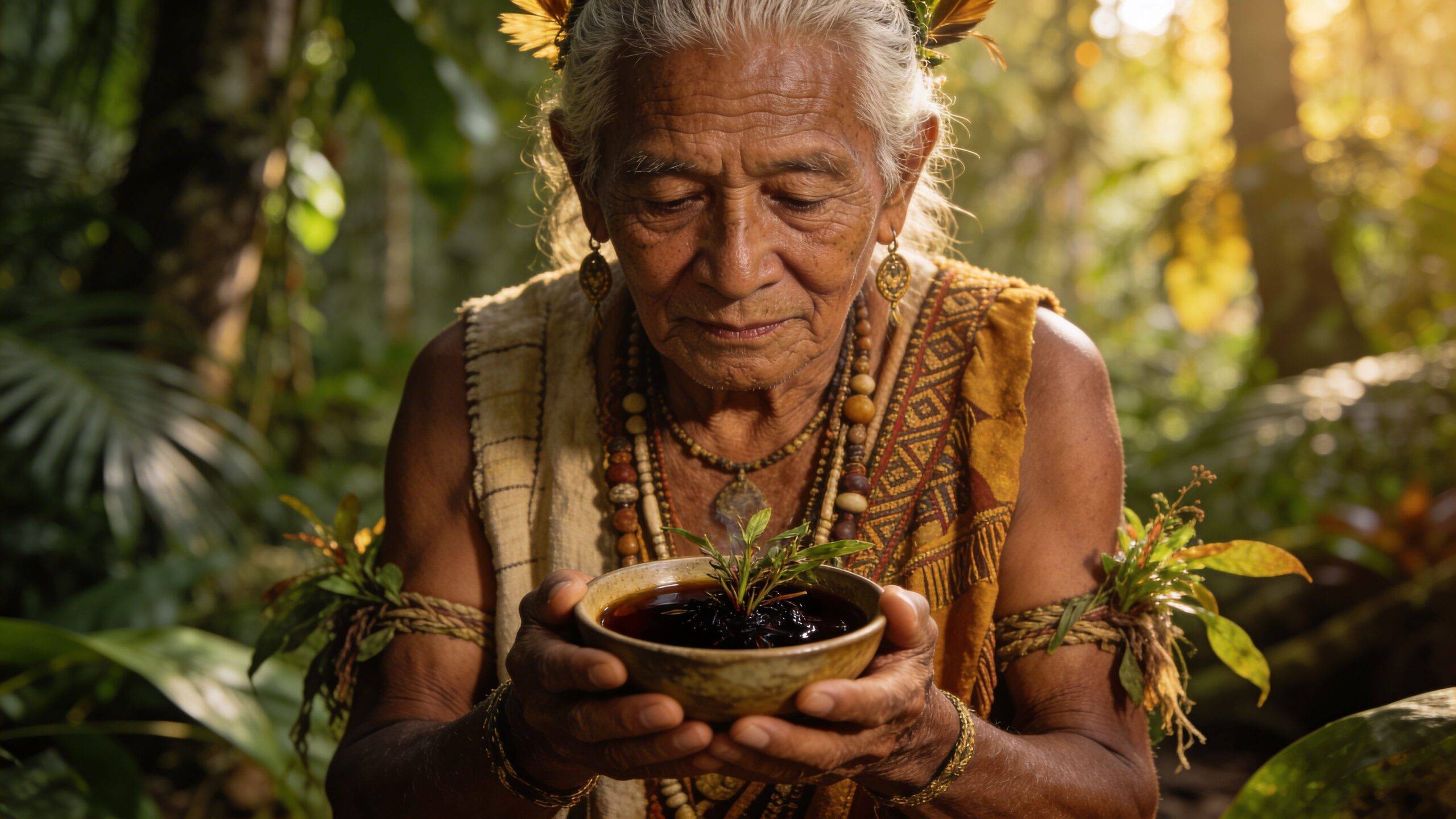
Ayahuasca is not a lifestyle accessory and not a novelty psychedelic. It is a sacred Amazonian brew with deep indigenous roots, used within ceremonial traditions as spiritual and physical medicine.
In practical terms, Ayahuasca is commonly made from Banisteriopsis caapi and a DMT-containing plant. Those plants matter. The ceremonial container matters just as much.
Why the traditional context matters
Many first-time seekers focus on the brew itself. Experienced practitioners know the vessel around it shapes the outcome.
Traditional ceremonial work often includes:
- A trained guide or shaman: Someone who knows how to hold the energetic, emotional, and interpersonal field of the ceremony.
- Songs, prayer, and ritual structure: These aren’t decorative. They help direct attention, regulate fear, and support emotional movement.
- Communal containment: Healing often deepens when a group shares intention, discipline, and respect.
- A relationship to the medicine as teacher: This changes how people meet discomfort. They stop treating every difficult moment as a problem.
Without that context, people can reduce Ayahuasca to chemistry and miss half the process.
The role of purging
One of the most misunderstood aspects of Ayahuasca is la purga. Nausea, vomiting, bowel release, trembling, crying, and sweating can all show up in ceremony.
In many Amazonian traditions, this is not automatically seen as side effect in the ordinary medical sense. It is often understood as cleansing. Sometimes that cleansing feels physical. Sometimes it feels emotional or symbolic. Often it’s both.
A modern reader doesn’t have to adopt every traditional interpretation to appreciate the value of that frame. If someone enters ceremony believing every purge means danger, fear can escalate. If they understand that release is often part of the terrain, they can stay more grounded.
“The ceremony works best when people stop negotiating with every difficult sensation and start listening to what it may be clearing.”
Sacred doesn’t mean vague
Respecting sacred roots doesn’t require abandoning discernment. Good facilitators don’t hide behind mysticism. They explain the container, name the risks, and protect the integrity of the space.
A healthy ceremonial culture usually includes clear boundaries. People know who is leading, how support is offered, what happens if someone becomes overwhelmed, and what kind of preparation is expected. Sacredness without structure can become chaos. Structure without reverence can become sterile.
Traditional depth versus psychedelic tourism
The difference is easy to feel once you know what to look for.
| Approach | What it looks like |
|---|---|
| Traditional healing orientation | Clear lineage, disciplined ceremony, preparation, integration, humility around the medicine |
| Tourism orientation | Fast promises, vague screening, entertainment energy, little follow-up, pressure to consume the experience |
A legitimate healing path asks more of you. That’s a good sign.
When people honor the roots of Ayahuasca, they tend to approach it with patience, gratitude, and restraint. Those qualities are not side notes. They are part of the medicine.
The Science of Transformation How Ayahuasca Works
A person can spend years knowing their patterns and still feel unable to change them. Then, in ceremony, the pattern is not just understood. It is felt in the body, seen from another angle, and sometimes released with surprising force. That combination helps explain why Ayahuasca can lead to real change after the night is over.
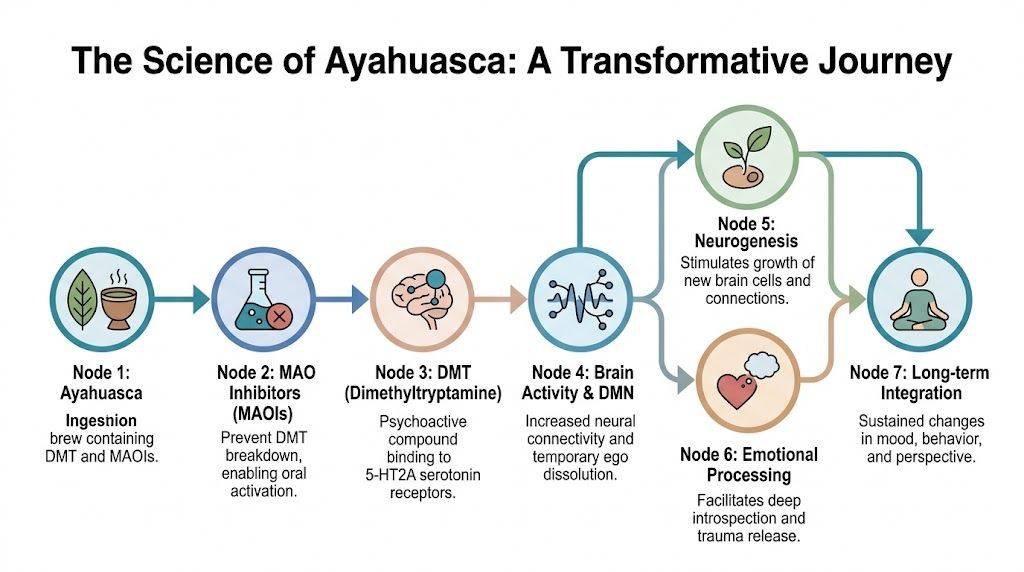
Traditional medicine lineages describe this as revealing what has been hidden. Modern research gives a different vocabulary, but it points toward the same practical bridge. The brew changes brain chemistry and perception at the same time, which can open a temporary window for emotional learning, memory reconsolidation, and shifts in behavior.
The chemistry in plain language
DMT is the most recognized psychoactive compound in Ayahuasca. Taken orally on its own, it would usually be broken down before producing much effect. The β-carbolines in Banisteriopsis caapi act as MAOIs, allowing oral DMT to remain active and adding psychoactive and physiological effects of their own. The brew works through that relationship between plants, not through a single isolated compound.
In practice, this matters because many people arrive in rigid loops. The same fear response. The same self-judgment. The same relational defenses. Ayahuasca can loosen those loops for a period of time, and that temporary flexibility gives people a chance to meet old material differently.
That window does not guarantee healing. It creates conditions where healing becomes more possible.
What brain measurements suggest
Researchers studying Ayahuasca with EEG and MEG have reported shifts in brain activity that line up with what people describe during ceremony. Findings summarized in this review of past and current research on Ayahuasca include reduced alpha power and later increases in gamma activity, patterns associated with changes in attention, imagery, memory processing, and emotional salience. Related discussion appears in the supporting paper at the National Library of Medicine.
The technical language matters less than the human meaning. People often report vivid autobiographical memories, symbolic scenes, unusual clarity around relationships, and access to grief or fear that had been tightly defended. Those reports are subjective, but they are not random. They appear alongside measurable changes in how the brain organizes perception and internal experience.
I often explain it this way to people preparing for ceremony. The visions are not the point by themselves. The value is that the nervous system may become more receptive while the mind sees old material with less avoidance and more honesty.
Why mystical experience can support practical healing
Mystical experience and therapeutic benefit are often treated as separate categories. In lived experience, they frequently work together.
A vision of an ancestor, a felt sense of forgiveness, or a powerful encounter with death and rebirth can sound abstract from the outside. Inside the ceremony, those moments can interrupt rehearsed beliefs such as “I am broken,” “I am alone,” or “I cannot survive this feeling.” When those beliefs loosen, the body often responds too. Breath changes. Defenses soften. Emotion moves. New choices become easier to practice afterward.
That is the bridge many people miss. The symbolic content may be personal or spiritual, but the outcome can be concrete. Reduced avoidance. Greater emotional range. Less compulsive behavior. More capacity to pause before repeating a familiar pattern.
Of course, intensity alone proves very little. Some ceremonies are dramatic and leave little behind. Others are quiet and lead to steady change over months because the person understood what was shown and took responsibility for acting on it.
What helps change last
Helpful ceremonies usually combine a few conditions.
- Clear intention: A grounded reason for sitting helps organize the experience without forcing it.
- Emotional willingness: People who can stay present with grief, fear, shame, or truth tend to get more from the work.
- Skilled containment: Good support lowers panic and helps difficult material become workable instead of overwhelming.
- Time for integration: Journaling, therapy, bodywork, honest conversation, and behavior change help turn insight into recovery.
A few patterns regularly weaken outcomes.
- Chasing spectacle: Strong visuals can impress the mind while leaving core patterns untouched.
- Repeating ceremonies without reflection: More nights with the medicine do not automatically create more healing.
- Using Ayahuasca to avoid ordinary work: Repairing relationships, setting boundaries, grieving fully, and changing habits still have to happen in daily life.
The medicine may open the door. The person still has to walk through it.
Common Paths to Healing Depression PTSD Addiction and Grief
A person can spend years saying, “I know why I feel this way,” and still remain caught in the same depression, the same trauma response, the same craving, or the same frozen grief. Insight alone often does not change the body, the nervous system, or the habits built around pain. That is why this work matters when it is done with care. Ayahuasca can bring buried material into conscious experience and, at the same time, create conditions that support emotional processing, new learning, and different choices afterward.
People arrive with different diagnoses. The deeper pattern is often similar. Something painful has been split off, overcontrolled, numbed, or repeated until it feels like identity.
Ayahuasca tends to affect healing through several channels at once. A person may see symbolic imagery, feel intense emotion, remember neglected experiences, and sense their life from a wider perspective. Those subjective events are not separate from healing. They often correspond to psychological reappraisal, reduced avoidance, and a temporary increase in cognitive and emotional flexibility. If the person is prepared and supported, that shift can become practical change.
Depression and the collapse of inner movement
Depression often looks like sadness from the outside. From the inside, it often feels heavier than that. Thought slows down. Possibility narrows. The future stops feeling real.
In ceremony, I often see depressed people regain movement before they regain hope. They cry after months of flatness. They feel anger that had been turned inward. They remember parts of themselves that were buried under defeat or self-judgment. That matters because depression is not only a belief problem. It is also a problem of constriction.
Ayahuasca may loosen that constriction by interrupting rigid mental loops and increasing access to emotion and perspective. A vision, a memory, or a clear bodily release can help someone stop treating an old wound as proof of who they are. The ceremony itself is not the treatment plan. The value is that it can create enough inner movement for therapy, relationships, sleep, exercise, and honest self-care to start working again.
PTSD and trauma held in the body
Trauma changes attention, expectation, and physiology. The person may know the event is over while their body still acts as if danger is close.
Ayahuasca can bring traumatic material forward in a way that feels direct but not always literal. Some people relive. Others receive symbols, fragments, or body sensations that carry the emotional truth of what happened. In the best cases, they stay connected to the experience without losing all orientation. That combination can support reprocessing. Fear is felt. Meaning shifts. The nervous system learns that contact with the memory does not always end in helplessness.
This is one of the clearest places where mystical experience and clinical language meet. A person may say, “I went back and freed the child I used to be.” In psychological terms, that can reflect memory reconsolidation, self-compassion, and a change in how traumatic material is organized. Both descriptions point to the same question. Does the person leave less defended, less fragmented, and more able to live in the present?
The setting has enormous influence here. Trauma work can heal, or it can flood the person. Skilled facilitation, pacing, and aftercare shape the difference.
“The ceremony may open material that has been sealed for years. Healing depends on whether the person can meet it, process it, and integrate it without being overwhelmed.”
Addiction and the deeper drivers beneath craving
Addiction is rarely just a love of the substance. More often it is an attempt to manage pain, emptiness, speed, shame, loneliness, or trauma.
Ayahuasca can interrupt addictive patterns in a few ways. It may expose what the addiction has been doing for the person. It may produce a strong aversive or clarifying experience around the behavior itself. It may restore meaning, connection, and self-respect, which many people in addiction have lost. On the biological side, researchers have examined how DMT and the brew’s beta-carbolines affect serotonin signaling, neuroplasticity, and the reward pathways involved in compulsive behavior. On the psychological side, the ceremony can break denial with unusual force.
Research also suggests that ritual context and integration are part of the outcome, not decoration around it, as discussed in this paper on Ayahuasca and addiction recovery. I have seen people leave ceremony with genuine relief from craving, then lose that gain because they returned to the same social world, the same secrecy, and the same daily triggers. I have also seen the opposite. A difficult ceremony became the turning point because the person accepted structure afterward. Meetings. Therapy. New friends. Better sleep. Real accountability.
Practical caution matters here too. People in recovery sometimes take medications or supplements that require careful review before ceremony. Foods and meds to avoid with MAOIs should be checked well before sitting, not the night before travel.
Grief and the restoration of relationship
Grief often gets treated as something to finish. That is not how deep loss works. Healthy grief changes form, but it does not always disappear.
Ayahuasca can help a grieving person move from mental narration into felt mourning. Tears come. Love returns with less defense around it. Regret may surface alongside tenderness. Some people experience contact with the dead, a sense of forgiveness, or a recognition that the bond continues in a different form. Whether those moments are understood spiritually, psychologically, or both, they can reduce the frozen quality that keeps grief stuck.
What matters is not proving the vision. What matters is whether the person becomes more able to love, remember, and live.
One medicine, different doorways
| Concern | What Ayahuasca may open |
|---|---|
| Depression | Emotional movement, relief from rigid self-story, renewed capacity to engage with life |
| PTSD | Access to traumatic material with new perspective, body-based release, reorganization of meaning |
| Addiction | Insight into what craving has been regulating, interruption of compulsion, renewed purpose |
| Grief | Fuller mourning, softened defenses, repaired bond with memory and love |
Two people can drink the same brew in the same room and walk away with very different forms of healing. One has visions. One has almost none. One shakes and weeps. One sits in stillness and leaves with a simple truth they can finally act on.
The outcome is measured later. Fewer panic responses. Less craving. More contact with feeling. More honesty. More ability to stay present when life hurts. That is where the ceremonial experience becomes real healing.
Navigating the Journey Safely Risks and Harm Reduction
Ayahuasca deserves reverence, but it also demands screening. Safety is not a side conversation. It is part of the medicine work.
The strongest centers treat medical history, psychiatric history, and medication review as essential requirements. If a retreat seems casual about contraindications, leave. A beautiful website does not make a safe container.
What the risk picture actually looks like
The Global Ayahuasca Survey found that 69.9% of respondents reported acute physical effects, most commonly nausea and vomiting at 68.2%, while only 2.3% required medical attention, according to ICEERS reporting on the survey’s adverse effects findings.
That tells us two things at once. First, physical intensity is common. Second, severe medical events were uncommon in that dataset. Both facts matter.
The same source also notes media-reported deaths among an estimated four million users, while stating that no forensic evidence has causally linked Ayahuasca itself, with cases attributed to external factors such as pre-existing conditions or dangerous admixtures. That is a strong argument for discernment, not complacency.
The main contraindications people must take seriously
Some risks come from the brew. Many come from who takes it, what they combine it with, and where they take it.
Key areas to review carefully:
- Medication interactions: MAOI interactions can be serious. If you’re evaluating compatibility, study this guide on foods and meds to avoid with MAOIs.
- Psychiatric vulnerability: A personal or family history involving psychosis calls for extreme caution and often exclusion.
- Cardiovascular or complex medical conditions: These require real medical review, not forum advice.
- Substance combinations: Retreats should clearly prohibit risky combinations and enforce that policy.
What harm reduction looks like in real life
Good harm reduction is not complicated, but it is demanding.
Ask direct questions before booking:
- Who reviews medical forms and what happens if something is unclear?
- What medications are excluded and how far in advance must they be addressed?
- Who is present during ceremony if someone becomes physically or psychologically overwhelmed?
- How are difficult reactions handled during the night and the next morning?
“A safe retreat does not promise that nothing difficult will happen. It shows you exactly how difficulty is managed.”
False confidence is a risk factor
People get into trouble when they treat Ayahuasca as natural therefore harmless, spiritual therefore self-justifying, or traditional therefore always safe in any setting.
Natural substances can interact powerfully with medications. Spiritual states can destabilize someone who isn’t properly screened. Traditional medicine still requires competent hands. A mature approach keeps all three truths in view.
A Framework for a Meaningful Journey Preparation and Integration
A strong ceremony starts before arrival and continues long after departure. That sounds simple, but it’s where many people fail themselves. They prepare for the peak and neglect the landing.
Research and field experience both point to the same gap. Retreats often focus heavily on the ceremony, while the 3-6 month period after the retreat can be where people most need support, especially when they’re dealing with isolation, confusion, or intense emotional material, as described by Fireside Project’s discussion of integration challenges after Ayahuasca retreats.
Preparation that actually matters
Preparation is not performance. It’s not about acting pure or trying to manufacture a perfect state. It’s about reducing noise so you can hear clearly.
Useful preparation usually includes:
- Medical honesty: Report everything. Medications, diagnoses, substance use, past instability.
- A workable intention: Choose a question or area of life. Keep it simple and sincere.
- Nervous system support: Sleep, reduced stimulation, less chaos, steadier routines.
- Relational cleanup where possible: Unfinished conflict often walks straight into ceremony.
Some people obsess over saying the right prayer or eating the perfect pre-retreat diet while ignoring the obvious. They’re in a destructive relationship, lying on intake forms, or hoping the medicine will make a decision they already know they need to make. Preparation means facing what’s already visible.
Integration is where healing becomes behavior
A ceremony may reveal. Integration is what you do with what was revealed.
Common post-retreat practices that help:
- Journaling with specifics: Write what you saw, felt, and understood before the mind edits it.
- Body-based grounding: Walk, stretch, breathe, rest, and reduce overstimulation.
- Selective sharing: Talk to people who can listen without trivializing or inflating the experience.
- Therapeutic follow-through: If trauma surfaced, get support that can help you process it skillfully.
- Concrete changes: One honest conversation, one boundary, one habit shift is worth more than ten grand theories.
The first months back home
Many people expect clarity after ceremony and are surprised by tenderness instead.
They may feel open, raw, inspired, disoriented, or all four in one day. Old patterns can briefly intensify before they settle. Relationships may feel misaligned. Work environments may suddenly feel louder than before. None of that automatically means something went wrong.
A practical way to move through the early integration period is to divide what happened into three categories.
| Category | Question to ask |
|---|---|
| Insight | What did I understand clearly about myself or my life? |
| Emotion | What feeling still needs to move, without being explained away? |
| Action | What one change can I begin this week that honors the experience? |
What does not help
There are a few common mistakes.
- Making major life decisions immediately: Give strong revelations time to settle.
- Trying to explain everything as literal: Symbolic content often unfolds over time.
- Booking the next retreat too quickly: More medicine is not always the answer. Sometimes digestion is.
- Returning to numbing habits at full speed: That can erase the opening before it stabilizes.
Integration asks for humility. The ceremony may show the path in a night. Walking it still takes months.
Choosing a Vetted Retreat What to Look For
Choosing a retreat is less about luxury and more about competence. You are not buying ambiance. You are choosing who will hold you if the night becomes intense, confusing, or emotional.
Start with the basics. If a center cannot answer direct questions clearly, treat that as useful information.
The questions worth asking before you book
A vetted retreat should be able to explain its process without evasiveness.
Ask about:
- Screening depth: Do they review medications, diagnoses, and mental health history carefully?
- Facilitator experience: Who leads the ceremonies, and what training or lineage informs their work?
- Support during and after ceremony: Is there structured integration, or only a closing circle?
- Group size and attention: Can participants realistically receive care if several people struggle at once?
- Ethics and boundaries: How do they handle touch, consent, privacy, and power dynamics?
If you want a starting point for your own self-assessment before evaluating programs, this guide on whether Ayahuasca is right for you is one practical resource.
Green flags and red flags
This comparison helps people cut through marketing language.
| Green flags | Red flags |
|---|---|
| Thorough intake and follow-up questions | Instant approval with minimal screening |
| Clear medication policies | Vague reassurance that “it should be fine” |
| Defined ceremony leadership | Confusing or hidden facilitator roles |
| Integration support beyond ceremony night | Little to no plan for aftercare |
| Respectful relationship to tradition and local context | Heavy sales energy or spiritual branding without substance |
Matching the retreat to your intention
Not every good retreat is the right retreat for you.
Some people need a more traditional jungle setting with strong ritual depth. Others need more clinical support, more structure, or a smaller group. Neither preference is morally superior. The point is alignment.
One practical option people use during research is Ayahuasca.com, which offers educational resources and a curated selection of vetted retreats. That does not replace your own due diligence. It gives you a place to start asking better questions.
The right center should make you feel informed, not persuaded. Calm confidence is a better sign than charisma.
Your Journey Forward Embracing the Path of Healing
You return home after ceremony, and the work of integration begins. The visions may already be fading. What remains is the part that matters most. The conversation you need to have, the habit you can no longer defend, the grief your body finally let you feel, the small daily choices that either support change or pull you back into the old pattern.
Ayahuasca can open a door. Healing depends on what you do once you walk through it.
In practice, the medicine often creates a rare combination of effects. People may feel buried emotion rise into awareness, see their life story from a wider perspective, or experience a drop in the usual defenses that keep pain locked in place. From a psychological and neurobiological view, those moments can create conditions for new learning. Old associations loosen. Avoided material becomes accessible. Insight gains traction when it is followed by repetition, regulation, and honest action in ordinary life.
That is why ceremony alone is rarely enough.
Respect has to stay at the center. Respect for the Indigenous traditions that carried this medicine forward. Respect for the medical and psychiatric realities that make screening necessary. Respect for the fact that a profound spiritual experience does not automatically repair relationships, stabilize the nervous system, or change destructive behavior.
As noted earlier, the broader research picture is encouraging. Still, no study can choose your retreat, tell the facilitators what medications you are taking, set boundaries for you, or help you keep a promise to yourself after you get home.
I have seen people leave ceremony with genuine clarity and lose momentum within a week because they treated the experience as an ending instead of a beginning. I have also seen modest insights, handled with discipline and support, lead to lasting changes in mood, sobriety, relationships, and self-respect. The difference is usually not the intensity of the night. It is the quality of the follow-through.
Keep the next steps plain and concrete. Rest. Reduce stimulation. Write down what felt true before the mind starts editing it. Speak with an integration therapist, trusted guide, or support circle that understands both trauma and altered states. Make one or two changes you can sustain.
Read carefully. Choose teachers and materials that treat Indigenous context, safety, trauma, and integration with seriousness. If you use educational platforms such as Ayahuasca.com during that process, use them as a starting point for discernment, not as a substitute for it.
The healing may begin in ceremony. The outcome shows up later, in your sleep, your choices, your relationships, your capacity to stay present when life asks something difficult of you. That is where the mystical becomes measurable.
Disclaimer: The information provided on Ayahuasca.com is for educational purposes only and is not intended as medical advice, diagnosis, or treatment. Ayahuasca is a powerful traditional Amazonian medicine and may not be suitable for everyone. Always consult with a qualified healthcare professional before making decisions related to health, mental well-being, medications, or the use of Ayahuasca.