
Microdosing is often presented as the easiest route to better mood, sharper focus, stronger creativity, and lasting personal growth. That popular advice skips the most important distinction: feeling different on a dosing day isn’t the same as becoming healthier, more focused, or more resilient over time. Current research points to noticeable short-term effects, mixed findings across outcomes, and no dependable proof that common microdosing routines create durable benefits.
Psilocybin mushrooms also deserve more respect than a productivity shortcut allows. They have long-standing relationships with traditional plant-medicine practices, while modern research is testing their effects under controlled conditions. A responsible view can honor both contexts without treating personal testimony as clinical evidence.
The Reality Behind Microdosing Mushroom Benefits
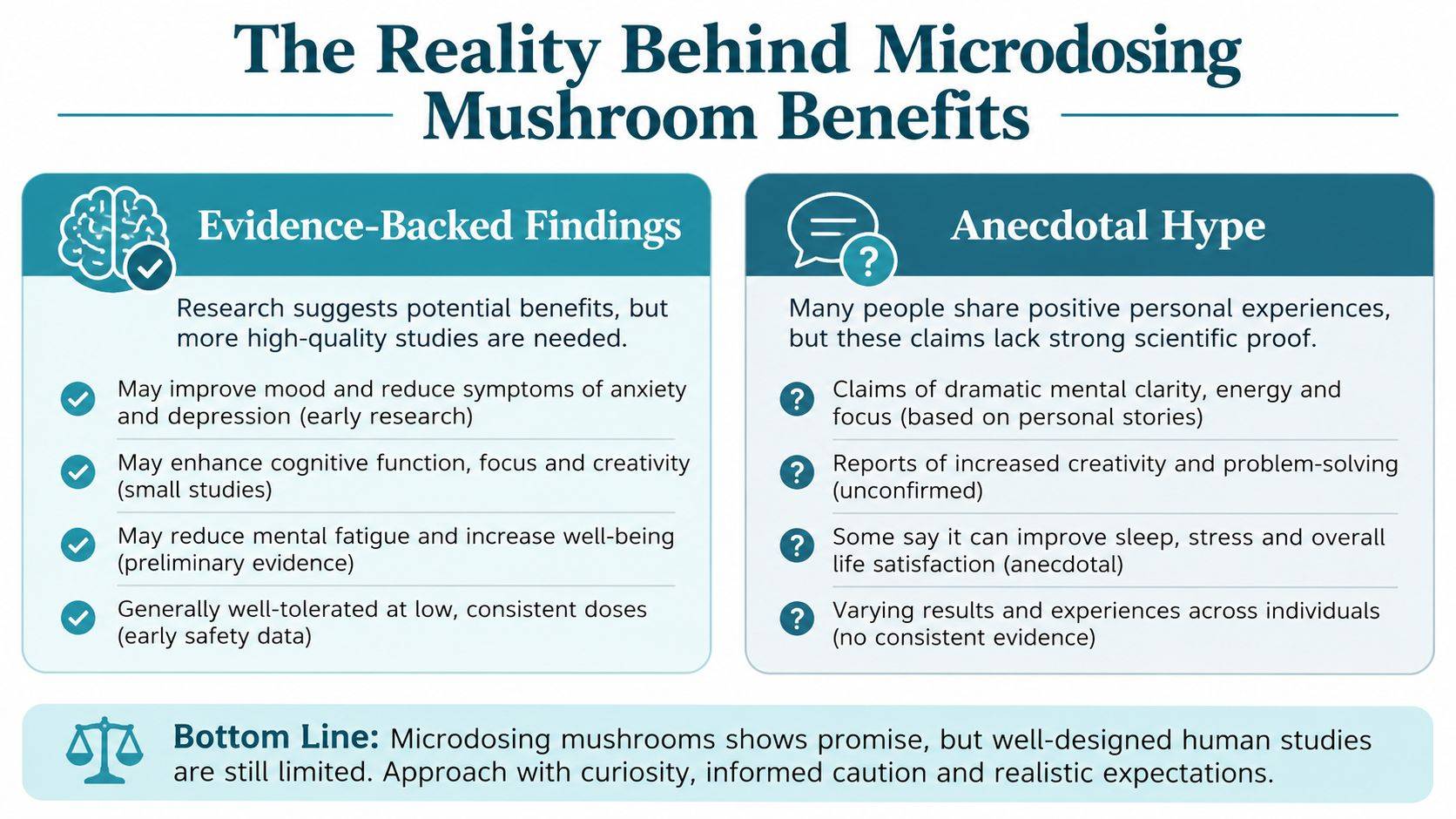
The strongest marketing claim is also the least established. Microdosing mushroom benefits are frequently described as a broad solution for anxiety, low mood, creative blocks, poor concentration, and everyday stress. Research doesn’t support that cure-all narrative. It suggests a more limited possibility, subtle effects that may be noticeable in the moment but don’t reliably continue after the substance has left the active experience.
A naturalistic observational study followed 953 psilocybin microdosers and 180 non-microdosing comparators for about 30 days, with a total sample of 1,133 people. The microdosing group reported small-to-medium improvements in mood and mental health, while older adults showed psychomotor performance gains. However, participants weren’t randomly assigned, and the microdosers were more likely to be older, employed full time, and White. Those characteristics matter because they show how early positive findings came from a large real-world cohort, not a laboratory trial. The observational study can identify patterns, but it can’t prove that psilocybin caused them.
What The Controlled Evidence Changes
Controlled studies complicate the optimistic story. A double-blind, placebo-controlled study found that low-dose mushrooms produced noticeable subjective effects and changed EEG rhythms, yet did not improve well-being, creativity, or cognitive function compared with placebo. Some measures shifted slightly toward cognitive impairment. The placebo-controlled study therefore supports a real neurophysiological effect without confirming broad performance gains.
A 2026 systematic review synthesized 11 studies. Eight studies, 72.7%, reported at least one positive health effect, while two studies, 18.2%, found no significant improvement on most outcomes, and one study, 9.1%, reported both positive and negative effects. The review in Frontiers in Psychiatry shows an expanding research literature, but its mixed results don’t justify universal promises.
“Practical rule: A noticeable effect deserves measurement, not automatic interpretation as a benefit.”
The central question is persistence. A 2026 meta-analysis covering 24 studies and 3,681 participants found subjective and neurophysiological effects but minimal impact on cognition, creativity, or sustained mood, with no clear immediate reduction in depressive, anxiety, or stress symptoms compared with placebo. The meta-analysis also found no significant moderation by dose range, dosing duration, or whether researchers assessed participants on or off the drug. Microdosing may be neither a miracle nor an empty experience. It’s a practice whose apparent value depends heavily on expectations, context, individual response, and the outcome being measured.
Understanding What Microdosing Means
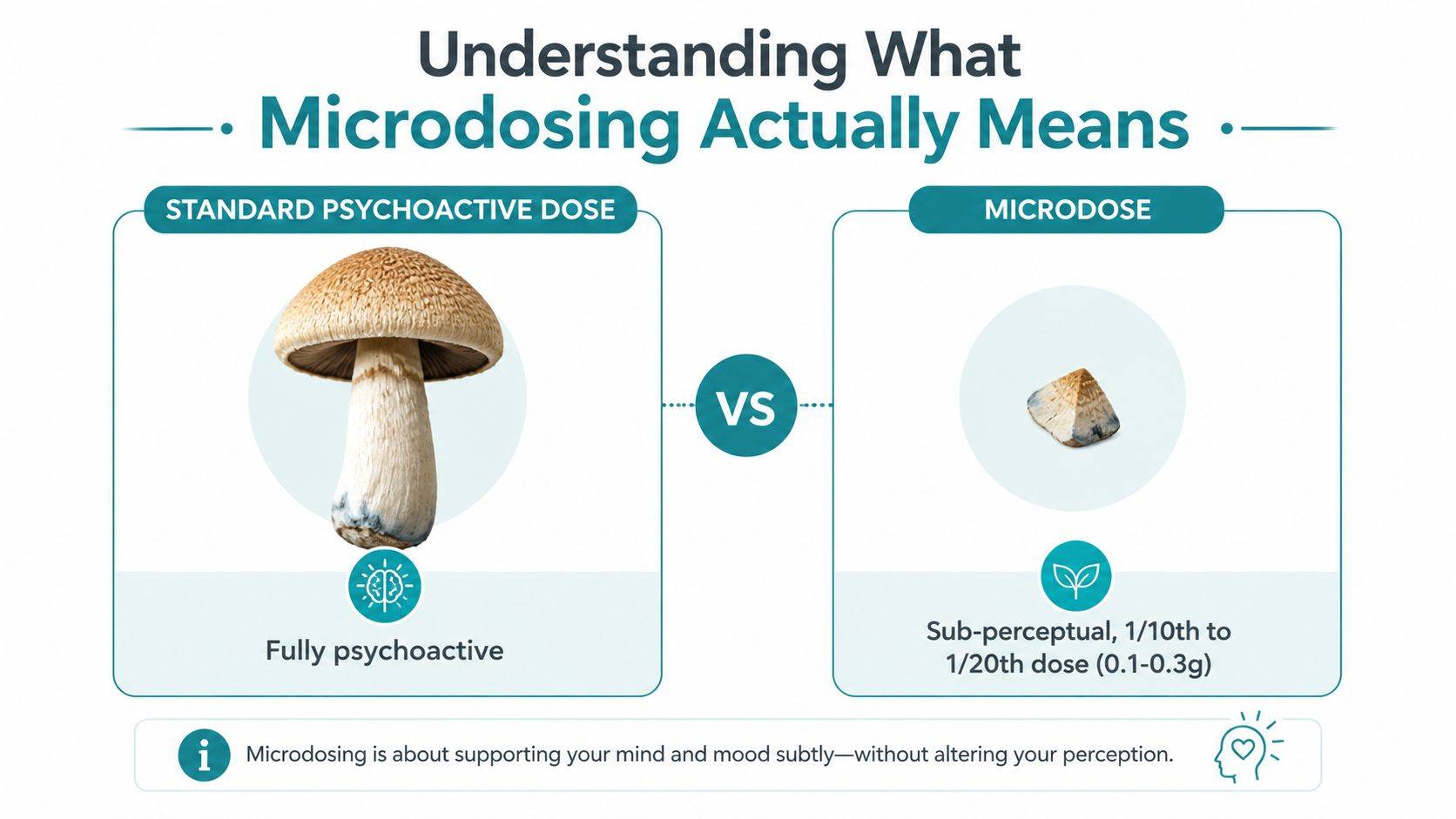
Microdosing generally refers to taking a sub-perceptual amount of a psilocybin-containing mushroom. Descriptions often place it around one-tenth to one-twentieth of a standard psychoactive dose, commonly discussed as approximately 0.1 to 0.3 grams of dried mushroom. Potency can vary substantially by species, batch, storage conditions, and preparation, so the same measured amount may not produce the same experience.
A full psychedelic dose can shift perception and emotion across the entire experience. A microdose aims for a smaller adjustment, allowing ordinary functioning while a person notices a possible change in mood, attention, sensory awareness, or emotional tone. The intended experience excludes visual hallucinations, ego dissolution, and obvious impairment. Still, sub-perceptual doesn’t mean biologically inactive. Feeling something on a dosing day also does not establish a lasting benefit.
Schedules And Their Rationale
Two widely discussed schedules show how people try to manage tolerance:
- One day on, two days off: This pattern creates non-dosing comparison days and limits continuous exposure.
- Four days on, three days off: Often linked with a “stacking” approach, it reflects theories about repeated exposure and neuroplasticity rather than established clinical guidance.
Neither schedule has demonstrated reliable long-term benefits across controlled studies. A schedule can organize observations, but it cannot resolve uncertainty about potency, expectancy, medication interactions, or personal vulnerability. Keeping notes on dosing days and non-dosing days may help separate a transient state change from a durable shift, although personal records cannot replace controlled research.
The practical distinction remains straightforward. A full dose is intended for an altered-state experience and requires a controlled setting. A microdose is intended to remain compatible with routine responsibilities, yet anyone who feels impaired should not drive, operate machinery, or make high-stakes decisions. Readers comparing low-dose approaches with other wellness formats can review how to micro dose CBD gummies from a CBD wellness source, while remembering that CBD and psilocybin involve different substances, effects, and legal considerations.
How Psilocybin Affects The Brain At Low Doses
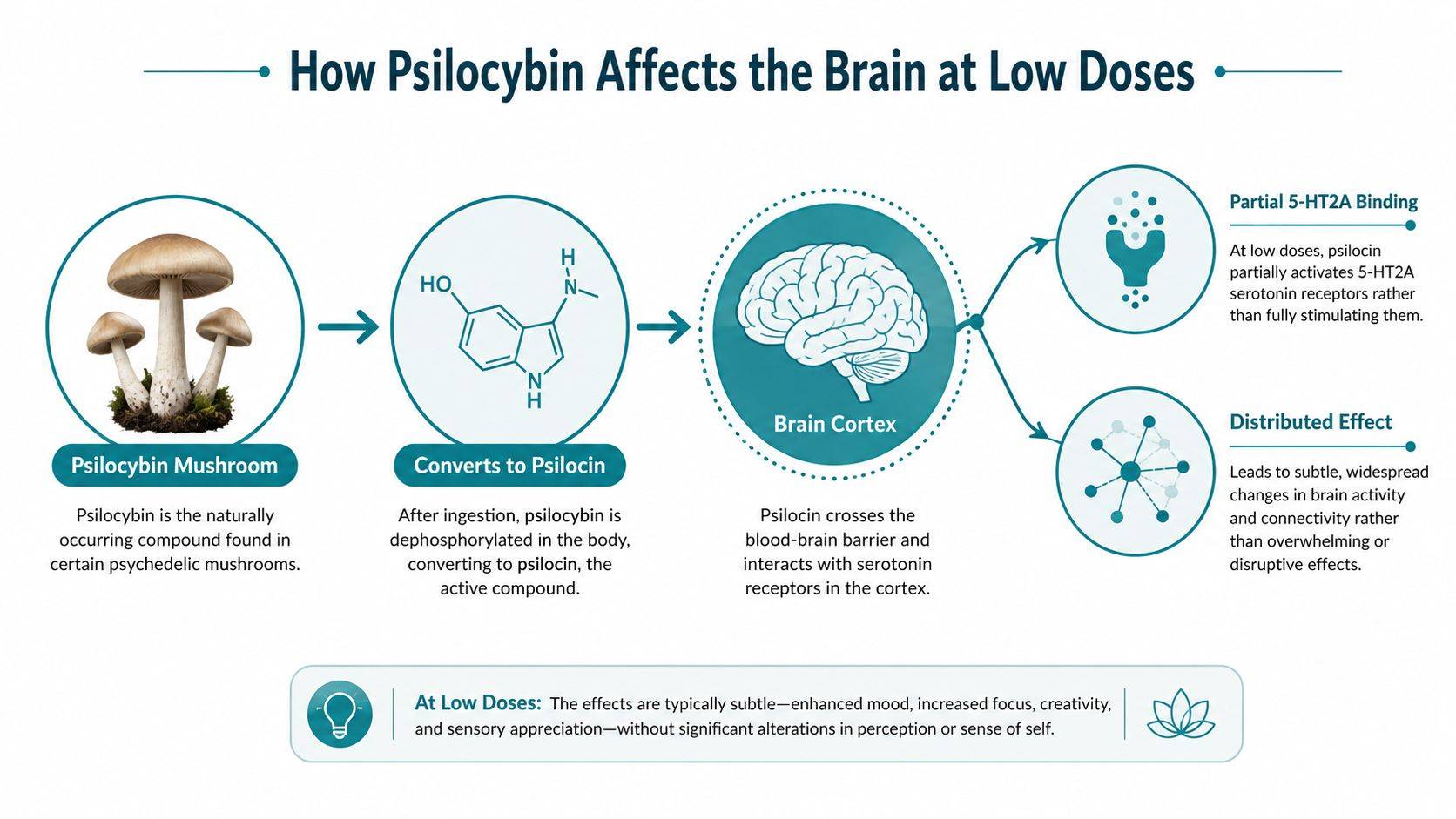
Psilocybin is converted in the body to psilocin, which acts primarily at serotonin receptors, including 5-HT2A receptors in the cortex. At higher psychedelic doses, this activity accompanies major changes in perception, emotion, and the organization of conscious experience. At lower doses, receptor activity may be more limited and distributed, although the exact subjective result varies by person and material.
That mechanism offers a plausible explanation for why some users describe a gentle shift rather than a full psychedelic state. A low dose may alter the salience of thoughts, emotions, or sensory input without producing the widespread disruption associated with a high-dose experience. Plausibility, however, isn’t proof of a meaningful wellness outcome.
Neuroplasticity Needs Careful Interpretation
Laboratory discussions often connect psychedelic compounds with processes related to neuroplasticity, including brain-derived neurotrophic factor expression and changes in dendritic spines. These mechanisms may help explain why researchers are interested in learning, emotional flexibility, and adaptation. They don’t establish that a person will become more creative, focused, or psychologically healthy from a particular microdosing routine.
The default mode network, often associated with self-referential thought and mental narration, provides another useful comparison. A full psychedelic experience can temporarily reduce the usual coherence of self-focused processing, which some people describe as ego dissolution. A microdose may produce a much gentler change in thought patterns, but claims about improved network flexibility require careful separation from subjective impressions.
Why Low Dose Doesn’t Mean Predictable Dose
Individual metabolism, receptor density, prior psychedelic experience, body composition, and mushroom potency can all influence the response. Two people consuming what appears to be the same amount may experience different levels of perceptual change, anxiety, or physical discomfort.
EEG findings show that low-dose exposure can alter brain rhythms, even when behavioral testing fails to show improved performance. That distinction is important. A measurable brain signal confirms that the compound is doing something, but it doesn’t identify whether the result is helpful, harmful, or irrelevant to a person’s long-term goals.
For readers exploring consciousness practices more broadly, practical steps for consciousness shift can provide a non-drug framework involving reflection, attention, and intentional behavioral change. Such practices also make clear that a shift in awareness is different from a durable improvement in daily functioning.
What Clinical Studies Reveal About The Evidence
Microdosing research becomes easier to understand when study designs are kept separate. Observational studies ask what people report in ordinary life. Randomized, placebo-controlled studies ask whether the substance creates an advantage beyond expectation and background change. Both approaches matter, but they answer different questions.
The naturalistic cohort described earlier found better self-reported mood and mental health among microdosers, with a psychomotor signal among older adults. That finding reflects real-world experience, but self-selection can influence who joins the study and how participants interpret their days. People who expect a benefit may be more likely to begin microdosing, continue it, and describe positive changes.
Controlled research produces a narrower picture. The double-blind mushroom study found noticeable effects and EEG changes without improved well-being, creativity, or cognitive function over placebo. This is a recurring pattern in the field: participants may feel a difference, while objective tests fail to show a broad performance advantage.
| Study / Institution | Design | Sample Size | Key Findings |
|---|---|---|---|
| Naturalistic observational study | Real-world comparison over about 30 days | 1,133 total | Small-to-medium mood and mental-health improvements, with psychomotor gains specifically among older adults |
| Double-blind mushroom study | Placebo-controlled, low-dose laboratory study | Not specified in the verified data | Noticeable subjective effects and altered EEG rhythms, but no improvement in well-being, creativity, or cognition versus placebo |
| 2026 systematic review | Synthesis of published microdosing studies | 11 studies | Positive effects appeared in some studies, while other studies found no improvement or mixed outcomes |
| 2026 systematic review and meta-analysis | Controlled evidence across psilocybin and LSD microdosing research | 24 studies, 3,681 participants | Subjective and neurophysiological effects, but minimal effects on cognition, creativity, sustained mood, depression, anxiety, or stress |
Why Blinding Is Difficult
Psychedelic microdosing creates a technical problem for placebo research. If participants notice changes in perception, body sensations, or mood, they may correctly guess which condition they received. Once the blind weakens, expectation can shape ratings and behavior.
A 2026 preregistered meta-analysis of 14 studies involving 1,614 participants found no detectable benefits for general intelligence, memory, or fluid reasoning. A 2026 microdosing trial likewise found no significant behavioral or subjective advantages over placebo after correction. These results don’t erase reports of on-day changes. They do weaken claims that microdosing reliably produces generalized cognitive enhancement.
Readers interested in the broader relationship between psychedelic research and mental wellness can explore this overview of psychedelic therapy research. Microdosing remains a distinct question from therapist-supported higher-dose treatment, and evidence from one approach shouldn’t be transferred automatically to the other.
Reported Benefits Across Different Domains
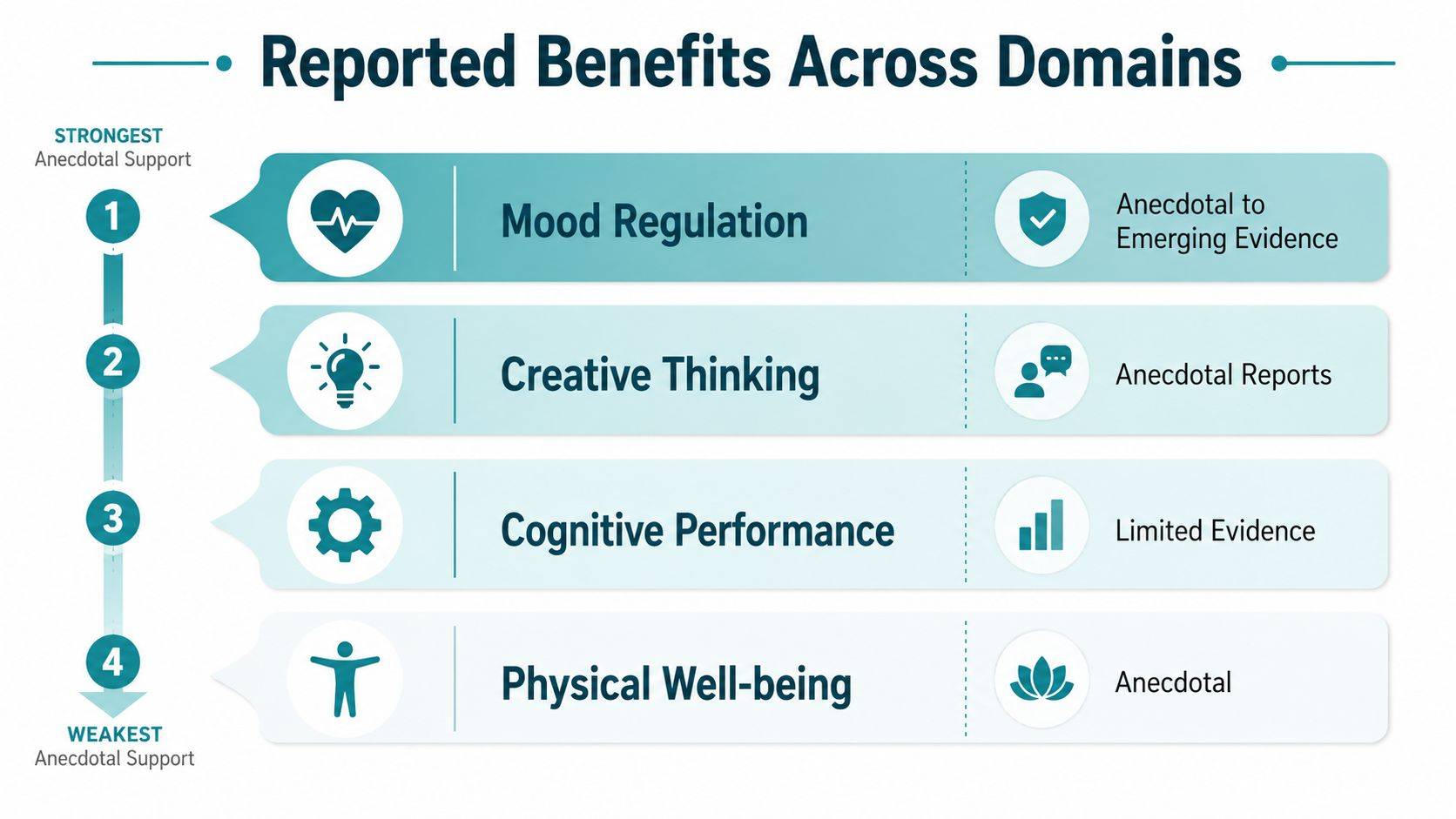
The phrase microdosing mushroom benefits covers several outcomes that shouldn’t be treated as interchangeable. Mood, creativity, cognition, and physical well-being involve different measurements, different expectations, and different levels of evidence.
Mood has the broadest real-world support, but controlled confirmation remains limited. In the observational cohort, microdosers reported small-to-medium improvements in mood and mental health. A 2019 empirical survey adds useful balance: improved mood appeared in 26.6% of coded responses, improved focus in 14.8%, physiological discomfort in 18.0%, and increased anxiety in 6.7%. The survey data show that positive and negative experiences can coexist.
A Domain-By-Domain Reading
Mood regulation appears promising as a subjective, short-term experience. People may report a lighter outlook or easier emotional processing on dosing days. The current evidence doesn’t establish that microdosing treats depression or anxiety, and controlled findings don’t show a clear immediate reduction in those symptoms compared with placebo.
Creative thinking has a narrower signal. A 2026 creativity study found that active microdosing improved the quality of divergent thinking, but not other creativity measures. The result depended on relative dosage and controls for placebo and demographic bias, so it doesn’t support a general creativity boost.
Cognitive performance has weaker support. Reports of focus, flow, and task initiation are common, yet controlled studies haven’t found reliable improvements in cognition. The preregistered meta-analysis found no detectable benefits for general intelligence, memory, or fluid reasoning.
Physical well-being remains largely anecdotal in the verified evidence. Users may describe changes in bodily comfort or discomfort, but the available data here don’t establish reliable benefits for migraines, cluster headaches, energy, or general physical health.
On-Day Effects Versus Durable Change
A 2026 UBC Okanagan report using the Microdose.me diary dataset found that people reported feeling more connected, creative, focused, and productive on microdosing days. Those effects didn’t appear to persist on non-dosing days. This distinction is central for anyone considering microdosing as a wellness practice. A temporary state enhancer may feel useful during a particular workday, while offering little evidence of better weekly functioning, sleep, or mental health.
Practical Considerations For Safe Microdosing
A harm-reduction approach begins with uncertainty. There isn’t a universally reliable microdose because mushroom potency varies, and a gram measurement alone doesn’t reveal the amount of active compound. The commonly discussed dried-mushroom range is approximately 0.1 to 0.3 grams, but that figure should be treated as a research and practice reference, not a personalized prescription.
Variables That Change The Experience
- Material consistency: Different species, batches, storage conditions, and preparation methods can produce different effects.
- Personal sensitivity: Metabolism, body composition, medication use, prior psychedelic exposure, sleep, and current mood may all influence the response.
- Schedule design: Built-in off-days can help a person observe baseline functioning and reduce the risk of mistaking continuous exposure for improvement.
- Daily context: A stressful environment, poor sleep, or a demanding responsibility can make a subtle psychoactive effect feel uncomfortable rather than helpful.
The popular “one day on, two days off” and “four days on, three days off” routines are best understood as informal frameworks. Controlled data haven’t shown that adjusting a schedule within commonly used ranges creates a dependable clinical signal.
Tracking Without Turning It Into A Ritual
A brief daily record can make observations more useful. The record might include mood, anxiety, sleep quality, concentration, task completion, physical sensations, and whether the person felt noticeably altered. The same questions should be answered on dosing and non-dosing days, preferably before expectations become strong.
“Measurement beats memory: A person who feels better on dosing days still needs to check whether the improvement appears in the days between doses.”
A careful process also includes an explicit stopping rule. If anxiety, sleep disruption, physical discomfort, distractibility, or emotional volatility increases, the practice shouldn’t be defended because the original intention was positive. Readers seeking broader personal-growth context can consult this practical guide to microdose mushrooms, while treating all mushroom use as subject to health screening and local law.
Risks And Legal Considerations You Should Know
Microdosing can produce unwanted effects even when a person intends to remain fully functional. The 2019 survey recorded physiological discomfort in 18.0% of coded responses and increased anxiety in 6.7%, alongside reported improvements in mood and focus. The survey’s findings illustrate why positive anecdotes shouldn’t be separated from adverse experiences.
Psychological risk deserves particular attention. A person with a personal or family history of psychotic disorders or bipolar disorder may face heightened vulnerability, and anyone with significant psychiatric symptoms should seek qualified medical advice rather than self-experiment. Cardiovascular conditions, pregnancy, and medication use also require professional assessment.
Interactions And Product Uncertainty
SSRIs and MAOIs can affect serotonergic systems and may complicate psychedelic effects. Alcohol can impair judgment and add uncertainty to an already variable experience. No one should start, stop, or combine psychiatric medication without guidance from a prescribing clinician.
Unregulated supply creates another problem. Misidentified species, contamination, uneven preparation, and inconsistent potency can make a target dose unreliable. A person may believe a capsule is sub-perceptual while experiencing noticeable psychoactive effects because the material wasn’t evenly measured or identified.
Law Is A Separate Question From Science
Psilocybin laws vary by jurisdiction. Some places have decriminalization policies, some permit limited research or therapeutic access, and others impose serious penalties for possession, cultivation, or distribution. Decriminalization doesn’t necessarily mean legal retail access, clinical approval, or protection from every consequence.
Ethical sourcing also matters. Commercial demand can encourage extraction from traditional knowledge without adequate respect for Indigenous communities, ecological limits, or cultural context. Readers exploring safety questions across sacred medicines can review this resource on Ayahuasca safety, while recognizing that Ayahuasca and psilocybin mushrooms are different substances with different pharmacology and risks.
Making Informed Decisions About Your Practice
A useful decision begins with the desired outcome, not the substance. Someone seeking temporary focus during a demanding day is asking a different question from someone hoping to change depression, anxiety, attention problems, or long-term emotional patterns. The current evidence supports keeping those goals separate.
The 2026 systematic review and meta-analysis of 24 studies and 3,681 participants found minimal effects on cognition, creativity, and sustained mood, with no clear immediate reduction in depressive, anxiety, or stress symptoms compared with placebo. That finding should shape expectations before any decision is made. A person looking for treatment shouldn’t substitute microdosing for established medical care.
A Practical Decision Filter
- Name the target. Choose one outcome, such as sleep quality, anxiety, task initiation, or mood stability. Broad goals make it difficult to interpret change.
- Establish a baseline. Record the target outcome during ordinary life before drawing conclusions about a new practice.
- Define success and harm. A useful experiment needs a clear improvement threshold and a clear reason to stop.
- Separate on-days from off-days. If change appears only during dosing, the result may be a transient state effect rather than durable adaptation.
- Invite outside perspective. A therapist, clinician, or trusted support person can identify worsening symptoms that self-monitoring misses.
- Review the evidence quality. Observational reports can generate ideas, while blinded randomized studies offer stronger tests of causation.
Turning A Short-Term Shift Into Change
If a person experiences greater openness, connection, or motivation, the lasting value may come from what happens afterward. Journaling can turn an impression into a specific behavioral intention. Therapy can help examine difficult emotions. Community support can reduce isolation and keep the person from treating every positive experience as proof of universal efficacy.
The research still needs longer controlled studies, standardized dosing materials, and more diverse participants. A 2026 estimate cited in the verified data placed U.S. past-year microdosing at about 9.5 million adults, or 3.7%, showing that public use is expanding while scientific certainty remains incomplete. The UBC Okanagan report highlights the practical gap: many people want to know whether an on-day effect becomes a better week.
For education, readers can use peer-reviewed literature, licensed clinicians, lawful research opportunities, and culturally respectful resources. Ayahuasca.com publishes educational material on sacred medicines, preparation, safety, and integration, which can help place psychedelic practices in a broader context without turning uncertain evidence into a promise.
Anyone considering microdosing should first review health history, medication interactions, psychological vulnerability, and local law with qualified professionals. A careful journal, clear stopping rules, and honest attention to non-dosing days can help distinguish a temporary feeling from a durable benefit. Readers should share this guide with a clinician or integration specialist before making decisions about psilocybin use, especially when depression, anxiety, bipolar symptoms, psychosis risk, heart conditions, or prescribed medication are involved.
Disclaimer: The information provided on Ayahuasca.com is for educational purposes only and is not intended as medical advice, diagnosis, or treatment. Ayahuasca is a powerful traditional Amazonian medicine and may not be suitable for everyone. Always consult with a qualified healthcare professional before making decisions related to health, mental well-being, medications, or the use of Ayahuasca.