
What is an ayahuasca ceremony? At its heart, it is a sacred, guided ritual where participants drink a traditional Amazonian plant brew. It is designed to open a door to the deeper parts of your consciousness, offering a path to profound psychological and spiritual insight within a safe, carefully held space.
Your First Glimpse Into an Ayahuasca Ceremony
Imagine the ceremony as a deeply intentional journey inward, a practice with roots stretching back centuries in the Amazon basin. The experience is a complete one, meticulously structured to support healing and self-discovery. The entire ritual brings specific elements together, all working in harmony to create a supportive container for what can be a very personal and powerful experience.
The core purpose is to provide a safe space for you to explore your own mind. The plant medicine, the experienced guide, the sacred setting, and your own personal intention all combine to create a powerful synergy. Each piece plays a vital role in how the journey unfolds.
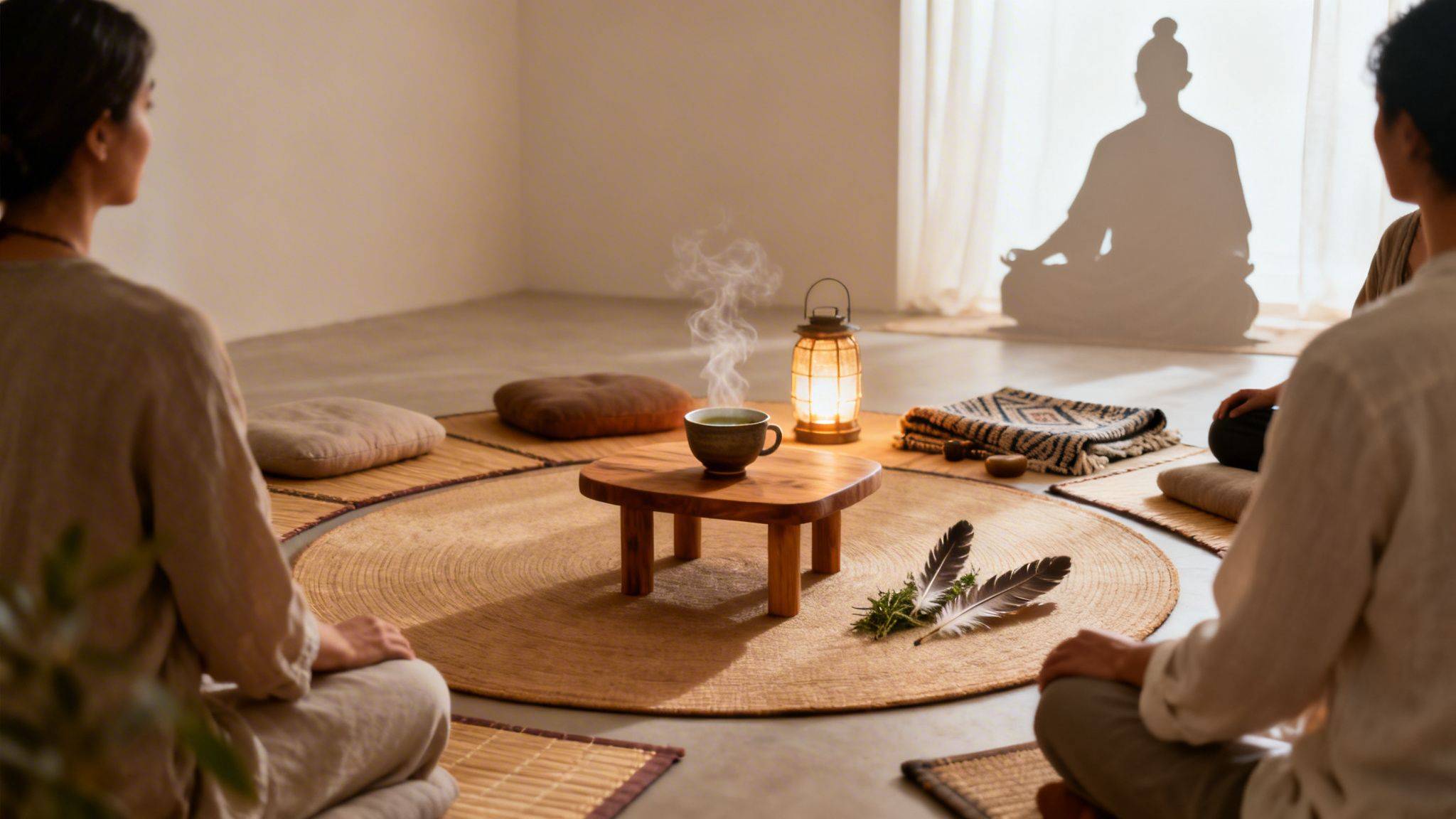
The Four Foundational Pillars
The best way to wrap your head around an Ayahuasca ceremony is to look at its four essential pillars. These are the non-negotiable elements that form the foundation of any traditional and responsibly conducted ceremony. They ensure the process is not only safe but also holds the potential for genuine, lasting insight.
“An Ayahuasca ceremony is a space where the veil between the conscious and subconscious mind becomes thin. It is designed to help you see, feel, and process things that are normally hidden from your everyday awareness.”
These four pillars are:
- The Medicine: This is the Ayahuasca brew itself, a blend of two distinct Amazonian plants. It acts as the key, unlocking different states of perception and feeling.
- The Guide: The shaman or facilitator is the ceremony’s anchor. They are responsible for holding the energetic space, ensuring everyone’s safety, and guiding participants with sacred songs (icaros) and gentle support.
- The Setting: The physical and energetic environment is crucial. The ceremony space must feel secure, calm, and respectful, allowing you to feel protected enough to surrender to the experience.
- The Intent: This is your personal “why,” the reason you’ve chosen to participate. A clear intention acts as your compass, helping you navigate the insights and challenges that may come up.
Every one of these elements is absolutely indispensable. A ceremony without a skilled guide, for instance, would be like setting sail on a powerful ocean without a captain.
To give you a clearer picture, this table breaks down these pillars, showing their distinct yet collaborative roles in a well-held ceremony.
The Four Pillars of an Ayahuasca Ceremony
| Pillar | Description | Role in the Ceremony |
|---|---|---|
| The Medicine | A sacred psychoactive brew from Amazonian plants. | Acts as the catalyst for the experience, opening access to deeper consciousness. |
| The Guide | An experienced shaman or trained facilitator. | Ensures physical and energetic safety, guides the journey with songs, and offers support. |
| The Setting | A safe, contained, and respectful physical space. | Creates a secure “container” for participants to navigate their inner worlds without external disturbance. |
| The Intent | The participant’s personal goal or reason for attending. | Provides focus and direction, helping to shape the nature of the insights received. |
When all four of these pillars are strong, they create a foundation of trust and safety, which is essential for the deep inner work that Ayahuasca facilitates.
The Sacred Brew and the Ceremonial Guide
Every authentic Ayahuasca ceremony revolves around two core elements: the sacred brew itself and the experienced guide who shepherds the journey. If you are still asking what is an ayahuasca ceremony, this core relationship between the brew and the guide is central to the answer. The medicine is the catalyst for the experience, but the guide is the one who helps you navigate the often-intense waters it opens up.
The Ayahuasca brew is not from a single plant. It’s a sophisticated alchemical recipe that combines two distinct Amazonian plants: the Banisteriopsis caapi vine and the leaves of the Psychotria viridis shrub. If you were to consume either one on its own, you wouldn’t feel much. But when they are brewed together for hours on end, a powerful synergy is unlocked.
It’s a brilliant bit of natural chemistry. The P. viridis leaves are rich in DMT, a powerful visionary compound. Normally, an enzyme in our gut (MAO) neutralizes DMT before it can reach the brain. This is where the B. caapi vine comes in; it contains compounds that naturally inhibit that enzyme. This inhibition allows the DMT to become orally active, cross the blood-brain barrier, and open the door to the visionary state Ayahuasca is known for.
The Role of the Shaman or Facilitator
The person leading the ceremony, often called a shaman, curandero, or facilitator, is so much more than a simple administrator. They are the spiritual and energetic anchor for the entire experience, tasked with creating a safe, sacred container for everyone present. Their guidance is a fundamental part of a responsible ceremony.
“A skilled guide doesn’t control your experience; they hold the space so you can safely surrender to it. Their role is to be a stable, compassionate presence, ensuring the environment remains protected from disturbances, both physical and energetic.”
Becoming a true guide requires years, sometimes decades, of rigorous training, apprenticeship, and countless hours of their own personal work with the medicine. They learn to navigate the spirit world and skillfully manage the powerful energies that surface. You can explore more about the profound role of the Ayahuasca shaman to understand their deep commitment and training.
Icaros: The Sacred Songs of the Ceremony
One of the most essential tools a shaman uses is the icaros, or sacred songs. This is not background music. The icaros are the primary technology for steering the energy of the ceremony. Each song is a specific vibration, a pattern of sound sung into the space to guide, heal, clean, and protect the participants.
Think of the shaman as a sonic architect, building and shaping the journey with their voice. The icaros can be used to:
- Open the ceremony: Calling in the plant spirits and setting a sacred container.
- Deepen the journey: Helping someone move through a difficult emotional block or access a profound insight.
- Perform energetic cleansing: Purging heavy or stuck energies from a person or the entire group.
- Provide protection: Weaving an energetic shield around the ceremonial space.
A shaman’s collection of icaros is a living library of their training and lineage. These songs are often passed down through generations or received directly from the plant spirits during their own diets and deep work. The songs become the very framework of the journey.
Maintaining Safety and Providing Support
Beyond the energetic work, the facilitator has a profound duty of care. Traditional ceremonies, rooted in Shipibo, Asháninka, and other Amazonian cultures, often take place at night inside a maloca (a ceremonial hut) and can last anywhere from 8-12 hours.
Throughout this entire time, the guide remains vigilant and completely sober. They are constantly attuned to the needs of each person in the circle, ready to offer a helping hand, a grounding word, or more specific energetic work if someone is navigating a particularly turbulent part of their experience. Their steady presence is a lifeline, reminding you that even in the most intense moments, you are safe and held.
Navigating Your Personal Ayahuasca Experience
So, what actually happens inside an Ayahuasca ceremony? While every person’s journey is unique, ceremonies follow a common rhythm. Knowing the general flow can help you feel grounded as you step into this profound space. Your journey doesn’t start when you drink the medicine; it begins weeks before with the dieta.
The dieta is a special preparatory diet that cleanses your body and helps quiet your mind. This means cutting out foods like salt, sugar, spicy dishes, red meat, and fermented products. It also includes abstaining from sexual activity and stimulants. Think of it as preparing the soil of your consciousness, making it fertile ground for the insights Ayahuasca can offer. By clearing out the noise, you create a more receptive state for the experience to unfold.
The Moment of the Brew
When the time comes, you’ll be called up to receive the Ayahuasca brew, usually served in a small cup. The taste is infamous for a reason: it’s intensely earthy, woody, and bitter. Most facilitators will encourage you to drink with intention, bringing your reason for being there to the front of your mind as you take the medicine.
Afterward, you’ll return to your mat. The room settles into a quiet, meditative stillness as everyone waits for the effects to gently begin. This is where patience and surrender become your greatest allies.
This visual shows how the two primary plant ingredients are combined to create the sacred brew.
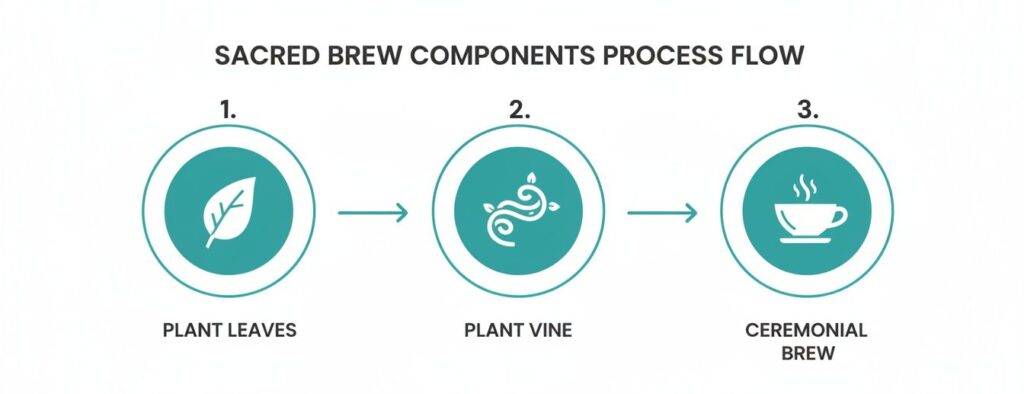
It’s the precise synergy between these two plants that unlocks the psychoactive journey central to the Ayahuasca experience.
Understanding the Physical Purge
One of the most well-known parts of an Ayahuasca ceremony is the physical purge, often called “la purga.” This frequently involves vomiting or diarrhea, and it’s a very common, expected part of the process. In the Amazonian tradition, this is seen as a deep physical and energetic cleanse.
The purge is considered a way of releasing old, stagnant energies, stuck emotions, and physical toxins you no longer need. It’s a purification that makes room for new healing and clarity to come in.
“While it can be physically intense, people often report feeling incredibly light, clear, and unburdened after purging. It’s seen as the medicine cleaning house, a necessary step before you can redecorate your inner world.”
Facilitators provide buckets and create a supportive atmosphere, so the entire process is handled with dignity. The shared understanding that this is a vital part of healing removes any sense of shame or embarrassment.
The Psychological and Visionary Journey
As the medicine deepens its effect, your inner world can come alive in profound and unexpected ways. The psychological and visionary aspects of the experience are rich, varied, and deeply personal.
Many people report experiencing a wide spectrum of phenomena:
- Vivid geometric patterns: Intricate, kaleidoscopic visuals often dance behind closed eyelids, sometimes moving in sync with the shaman’s songs (icaros).
- Deep emotional release: Powerful waves of feeling can surface, from long-held grief to pure, uninhibited joy. The medicine creates a safe space to finally feel and release these stored emotions.
- Life-altering insights: Moments of sudden, piercing clarity about your life, relationships, and ingrained patterns are very common. It’s like seeing the blueprint of your life from a completely new vantage point.
- A sense of connection: A powerful feeling of unity is a hallmark of the experience, a sense of being connected to all of nature, the universe, and your truest self.
The journey is not always easy or beautiful. It can be challenging, confronting you with difficult memories or uncomfortable truths. But even these moments are considered powerful opportunities for healing. You can learn more about the Ayahuasca experience to get a fuller picture of what’s possible. Ultimately, approaching your ceremony with openness and trust is the key to navigating both the light and the shadow of the journey.
Understanding the Essential Safety Protocols
An Ayahuasca ceremony can be a profound opportunity for healing, but it’s a journey that demands our full respect. Its power is real, and so are the risks if not approached carefully. Safety is, without question, the number one priority, and that starts with understanding the medical and psychological guidelines before you even consider sitting in a ceremony.
This is not a box-ticking exercise. A proper screening is the first line of defense for everyone involved. Any reputable retreat center will ask you to fill out a detailed medical history. Be completely honest, as certain health conditions and medications can create dangerous, even life-threatening, interactions with Ayahuasca.
Critical Medical and Medication Contraindications
The Ayahuasca brew is a combination of two plants, and one of them, the B. caapi vine, contains a Monoamine Oxidase Inhibitor (MAOI). This is a crucial element of how the medicine works, but it’s also why strict medical and dietary rules are so important.
When an MAOI is mixed with certain other substances, it can trigger a hypertensive crisis (a rapid, dangerous spike in blood pressure) or serotonin syndrome, a potentially fatal condition caused by an excess of serotonin in the brain.
Here are the most critical areas of concern:
- Heart Conditions: Anyone with a history of serious heart issues, like uncontrolled high blood pressure, coronary artery disease, or congestive heart failure, should not drink Ayahuasca. The medicine can temporarily raise both heart rate and blood pressure.
- Psychiatric Medications: The biggest red flag is antidepressants, particularly Selective Serotonin Reuptake Inhibitors (SSRIs) like Prozac, Zoloft, and Lexapro. Combining SSRIs with the MAOI in Ayahuasca is extremely dangerous. Other psychiatric drugs, including most antipsychotics and mood stabilizers, are also a no-go.
- Other Medications and Substances: The list of contraindications is long and includes many common prescription drugs, over-the-counter cold medicines, and even some herbal supplements. Stimulants and opioids are also on this list. To get a clearer picture, you can explore this comprehensive list of foods and meds to avoid with MAOIs and see why these precautions are necessary.
“Your physical safety is paramount. Full transparency with your facilitator about your health history and any medications you are taking is the cornerstone of a responsible Ayahuasca journey.”
Navigating Psychological Considerations
Just as important as your physical health is your psychological readiness. An Ayahuasca ceremony is designed to open you up, bringing what’s hidden in your subconscious out into the open. This often means facing unresolved trauma and difficult emotions head-on.
The experience can be incredibly challenging. You might find yourself moving through waves of deep grief, intense fear, or simmering anger. This is where a skilled facilitator and a well-held space are indispensable. They are there to provide a grounding presence, helping you navigate these moments without getting lost in them and reminding you that this release is part of the healing.
This is also why screening for certain psychological conditions is so critical. A personal or family history of psychosis, schizophrenia, or bipolar disorder usually means Ayahuasca is not a safe option, as the experience could trigger a psychotic or manic episode. Taking this journey requires an honest look at your own stability and whether you’re truly prepared for what the medicine may ask of you.
How to Choose a Safe and Authentic Ayahuasca Retreat
As Ayahuasca has stepped onto the global stage, retreat centers have popped up everywhere. While this means more options, it also presents a real challenge: how do you find a place that is genuinely safe and reputable? Doing your homework before you commit is one of the most important parts of this entire journey.
A truly authentic retreat is so much more than just the ceremony. It’s the whole container, the support system that’s in place from the moment you first inquire to the weeks and months after you’ve gone home. A responsible center is focused on your well-being above all else, honoring the deep traditions of the medicine while also using modern safety practices.
Key Questions for Vetting a Retreat
When you’re looking at different centers, you need to think like an investigator. The answers they give (or don’t give) will tell you everything you need to know about their integrity and commitment to your safety. A solid organization will not only expect your questions but will welcome them with transparency.
Here are the essential questions you should be asking any potential retreat center:
- What is the shaman’s or facilitator’s experience and lineage? Don’t be shy. Ask about their training, who their teachers were, and how many years they’ve been serving medicine. Real guides have dedicated years, often decades, to an apprenticeship.
- What is the facilitator-to-participant ratio? For an average-sized group, a good rule of thumb is about one facilitator for every five to seven people. This ensures there are enough hands on deck to provide support if anyone has a difficult time.
- What medical and emergency support is available? The center absolutely must have staff trained in first aid and CPR. They should also have a clear, rehearsed emergency plan and know exactly how to get to the nearest medical facility.
- How thorough is the medical screening process? Any legitimate center will have you fill out a detailed medical and psychological history form. This is non-negotiable, as it’s how they screen for serious contraindications.
- What does integration support look like? The work doesn’t end when the ceremony does. Ask what kind of post-retreat support they offer. Do they have group calls, one-on-one sessions, or provide resources to help you make sense of your experience?
“Choosing a retreat is an act of trust. Look for centers that operate with humility, transparency, and a deep respect for the sacred traditions they represent. The right environment will feel supportive and safe from your very first interaction.”
The Importance of Authenticity and Tradition
The explosion in Ayahuasca tourism has created a huge spectrum of offerings. Peru, for example, is home to the most centers, one analysis documented 232, which makes sense given its deep historical connection to the medicine. This market draws an estimated 15,000-20,000 foreigners to Peruvian centers every year, generating a lot of income and making it crucial for seekers to be discerning. Platforms like Ayahuasca.com are a great resource, as they vet retreats to ensure they honor indigenous wisdom and prioritize safety. You can read the full analysis on this trend to get a better sense of the landscape.
An authentic retreat usually works directly with indigenous shamans or with facilitators who have undergone extensive, long-term training within a specific lineage, like the Shipibo tradition. You’ll feel it in the way they operate; they treat the medicine, the songs (icaros), and the rituals with a deep sense of reverence, not as a product to be sold.
This respect for tradition is a dead giveaway of a center’s integrity. It shows they understand that an Ayahuasca ceremony is a sacred ritual, not just a wild trip. Be wary of any operation that feels slick and overly commercialized, makes grand promises of a “cure-all,” or is shady about their facilitators and safety protocols. At the end of the day, the best retreat for you is the one that aligns with your gut feeling and puts your safety and healing above all else.
Bringing the Journey Home Through Integration

An Ayahuasca ceremony can feel like it cracks your world wide open, showing you possibilities you never knew existed. But the ceremony itself is just the beginning. The real, lasting work starts the moment you return to your daily life. This is where integration comes in; it’s the essential practice of making your profound insights stick.
Think of it this way: the ceremony opens a door. Integration is the conscious, everyday process of actually walking through that door. It’s about weaving the lessons, feelings, and new perspectives from your journey into the fabric of your life, your thoughts, your habits, your relationships. Without this commitment, even the most powerful revelations can evaporate, becoming little more than a fascinating but distant memory.
The weeks and months following a retreat are a uniquely sensitive and valuable period. Your mind is often more flexible and your emotional patterns are more pliable. This gives you an incredible window of opportunity to consciously reshape your life to align with the clarity you’ve gained.
Grounding Yourself After the Ceremony
Coming back from the intensity of an Ayahuasca ceremony can be jarring. The first and most important step is simply to ground yourself. You might feel emotionally raw, more sensitive, or like your senses are turned up to eleven. It’s vital to be gentle with yourself and create a soft landing as you re-enter your normal routine.
Simple grounding practices can make all the difference here. Spending quiet time in nature, eating clean and nourishing food, and prioritizing rest will help your nervous system recalibrate. Try to ease back into your work and social life instead of diving in headfirst. Giving yourself this space is key to processing your experience without feeling totally overwhelmed.
“The point of integration is not to cling to the visionary high of the ceremony. It is about taking the truth you found there and learning to use it as a compass for navigating your everyday life with more purpose and honesty.”
Practical Tools for Lasting Change
Effective integration isn’t just a vague idea; it’s built on tangible, daily practices. These tools are your anchor, helping you stay connected to your insights and translate them into real-world actions. Most people find building a personal toolkit with a few different practices creates the strongest support system.
Some of the most tried-and-true integration tools include:
- Journaling: This is non-negotiable for many. Writing down your thoughts, feelings, and memories from the ceremony is a powerful way to find clarity. Your journal becomes a personal map of your journey, a place you can return to again and again to uncover new layers of meaning and see how far you’ve come.
- Meditation and Mindfulness: A regular meditation practice helps you maintain that deep connection to your inner world that the ceremony illuminated. It strengthens your ability to simply watch your thoughts and emotions without getting swept away by them, a core skill for embodying the lessons of Ayahuasca.
- Community and Coaching: You don’t have to do this alone. Sharing what you’re going through with people who get it is incredibly validating. This could mean finding an integration circle, leaning on a trusted community, or working with an integration coach who can offer personalized guidance.
Ultimately, your commitment to these practices is what turns a powerful psychedelic experience into genuine, positive change. The Ayahuasca ceremony can show you what’s possible; your integration work is what makes it real.
Common Questions About What Is an Ayahuasca Ceremony
It’s only natural to have a lot of questions when you’re exploring something as profound as an Ayahuasca ceremony. The topic is surrounded by mystery and misinformation, so let’s clear up some of the most common concerns people have before they decide to sit with the medicine.
Is Ayahuasca Legal?
The short answer is: it’s complicated. The legal status of Ayahuasca varies dramatically around the world, so doing your own homework for the specific country you plan to visit is essential.
In its native South American heartlands, like Peru, Brazil, and Colombia, Ayahuasca often has a protected cultural or even legal status, particularly when used within traditional indigenous and religious contexts.
On the other hand, in the United States, Canada, and most of Europe, the brew itself is usually illegal. This is because its primary psychoactive component, DMT, is classified as a controlled substance.
There are, however, important exceptions. Certain religious groups, like the União do Vegetal (UDV), have won landmark court cases that grant them the right to use Ayahuasca as a protected religious sacrament.
Because the legal landscape is a patchwork of different rules, you can’t make assumptions. Always verify the local laws yourself. Responsible participation starts with legal awareness.
Will I Lose Control During the Experience?
This is probably the biggest fear people have, and it’s completely understandable. The idea of losing control can be terrifying. While Ayahuasca guides you into a deeply altered state of consciousness, the experience is not like blacking out or losing your mind. You almost always remain aware of who you are and where you are.
Most people describe the experience as a kind of waking dream. You are fully immersed in the inner journey, but your core sense of self remains. A huge part of the work is actually learning to surrender and not try to control the experience. Fighting the medicine often creates anxiety, whereas letting go allows the healing to unfold.
“The role of a skilled facilitator is to create an environment of absolute safety. Their presence ensures the ceremonial space is a secure container, giving you the confidence to let go and explore your inner world without fear of losing control.”
This is why the shaman’s or facilitator’s role is so critical. They are holding the space for you, so you can safely let go. You are guided, not abandoned.
How Long Do the Effects Last?
Once you drink the brew, the most intense part of the journey typically lasts for about four to six hours. The experience is not a straight line; it ebbs and flows in waves. You’ll likely move through periods of deep introspection, powerful emotional releases, and incredible visionary states.
But the work doesn’t just stop when the ceremony ends. Many people describe an “afterglow” effect, a period of lasting clarity, emotional openness, and a deep sense of connection that can linger for weeks or even months.
Ultimately, the long-term benefits depend on your commitment to integration. The insights you receive in a ceremony are like seeds planted in the garden of your mind. Integration is the patient work of tending to them, so they can grow into real, lasting change in your daily life.
How Much Does an Ayahuasca Retreat Typically Cost?
The cost of an Ayahuasca retreat varies quite a bit. It really depends on the location, how long the retreat is, the quality of the facilities, and of course, the experience and lineage of the facilitators.
As a general benchmark, a week-long retreat in South America can range anywhere from $1,500 to over $5,000. A reputable center’s fee will almost always include:
- Multiple Ayahuasca ceremonies
- Lodging and diet-friendly meals
- Supportive practices like yoga, meditation, or breathwork
- Guidance for integrating the experience after you go home
While your budget is obviously a factor, this is not the time to bargain-hunt. Choosing a retreat just because it’s the cheapest option can be a serious gamble with your physical and psychological safety. Think of it as an investment in your well-being; prioritizing a center’s reputation, safety protocols, and ethical standards is always worth it.
Disclaimer: The information provided on Ayahuasca.com is for educational purposes only and is not intended as medical advice, diagnosis, or treatment. Ayahuasca is a powerful traditional Amazonian medicine and may not be suitable for everyone. Always consult with a qualified healthcare professional before making decisions related to health, mental well-being, medications, or the use of Ayahuasca.