
A first encounter with an icaro can unsettle ordinary expectations about music. In a dim ceremony space, a healer’s voice may enter softly, circle through repeated phrases, and then gather strength as the effects of Ayahuasca deepen. Participants often discover that the song seems to provide orientation when familiar thoughts, memories, and sensations no longer follow their usual sequence.
Medicine songs deserve careful attention because they can function as active therapeutic instruments, not merely as background sound. In Amazonian traditions, the singer may use voice, rhythm, repetition, breath, and silence to help shape the emotional direction of a ceremony. The practice carries cultural knowledge, spiritual responsibility, and practical skill, so respectful understanding begins with listening rather than imitation.
The Navigational Power of Sacred Sound
The room is quiet until the first notes arrive. A shacapa may rustle near the healer’s body, a voice may rise and fall in a narrow melodic path, and the participant may feel a sudden change in the atmosphere. The song doesn’t explain the experience in ordinary language. Instead, it offers a recognizable thread through sensations that may feel unfamiliar or overwhelming.
That thread can become an auditory anchor. A participant who feels disoriented may return attention to the singer’s pulse, vowel sounds, or recurring melodic phrase. Someone moving through grief may experience the same song as a container, allowing emotion to unfold without requiring immediate analysis.

The Singer Holds Responsibility
In many ceremonial settings, the healer responds to the group rather than following a fixed playlist. A change in pace, volume, vocal register, or repetition may accompany a shift in the emotional tone of the room. The participant may not know what the song means, yet the voice can still communicate presence, direction, and containment.
This makes the relationship between singer and participant central. A skilled practitioner needs cultural training, ceremonial discipline, and sensitivity to the people present. A participant, meanwhile, needs enough trust to remain attentive without surrendering personal boundaries or critical judgment.
“Practical rule: A medicine song should be approached as part of a relationship and a responsibility, not as a decorative sound effect”
The navigational role of an icaro also explains why recorded music can’t automatically replace live singing. A recording offers a stable sequence, while a live healer can listen, pause, soften, intensify, or redirect. That distinction becomes especially important when a ceremony includes difficult memories or strong emotional responses.
Medicine songs therefore operate on several levels at once. They’re musical performances, cultural inheritances, ceremonial actions, and possible supports for emotional regulation. Treating them only as pleasant ambience misses the way a singer may use sound to help a participant remain connected to the unfolding experience.
Indigenous Roots and Historical Repertoires
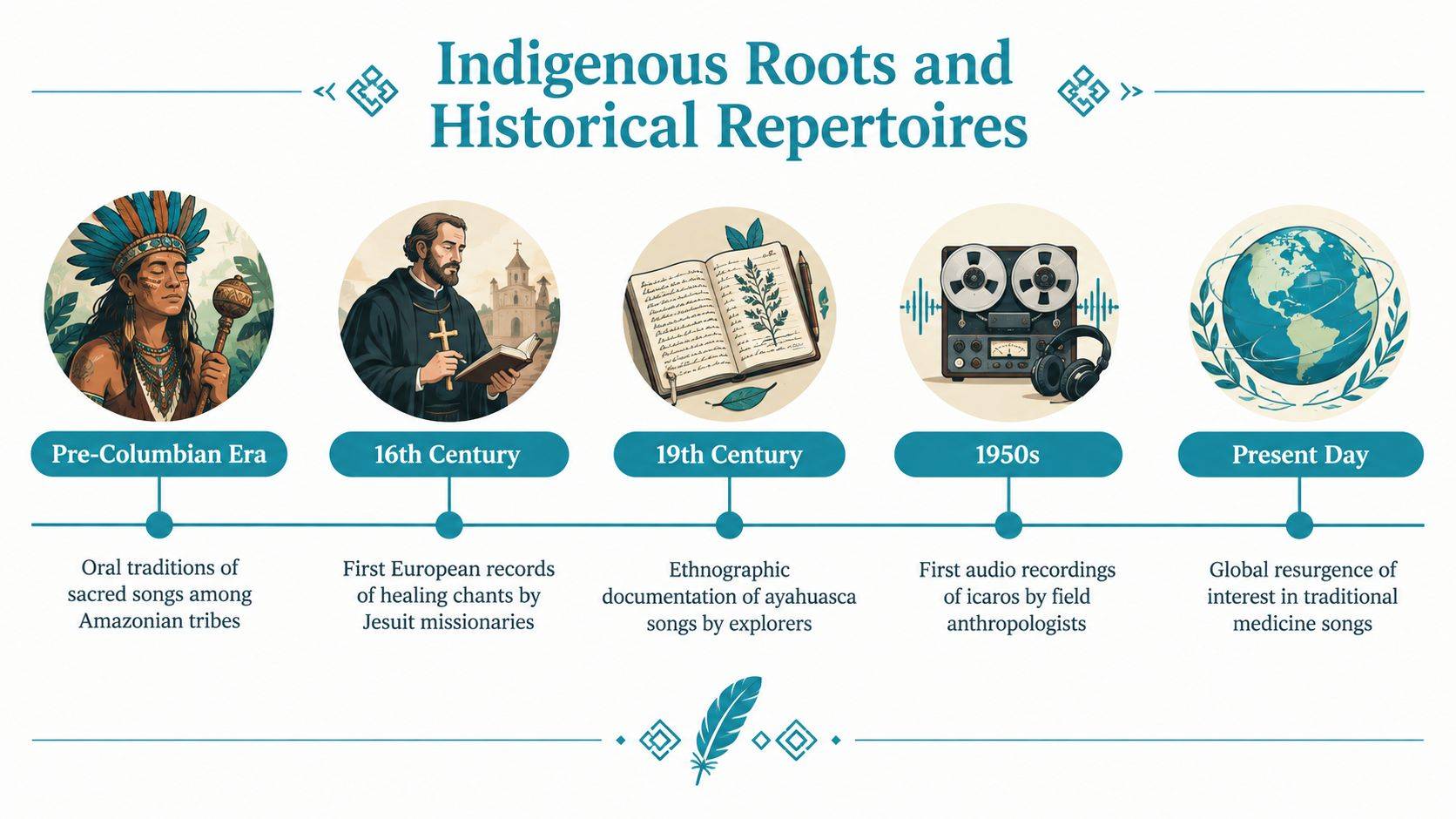
Medicine songs belong to broader healing systems that include relationships with plants, ancestors, places, animals, and community responsibilities. Their presence across Indigenous traditions challenges the assumption that healing songs are spontaneous additions to a ceremony. Documentation shows that many communities maintain specialized repertoires, with particular songs associated with particular healers, treatments, stages, or intentions.
A Smithsonian survey of healing songs in American Indian traditions recorded 197 songs across 14 groups where healing songs were documented. The Smithsonian Folkways documentation of healing-song traditions also notes that some songs may be repeated many times during treatment, while certain healers maintain songs for the beginning and ending of a cure. The evidence points to a structured therapeutic sequence rather than casual singing.
Oral Knowledge Can Be Highly Organized
Oral transmission doesn’t mean unstructured transmission. A song can carry information about when to sing, whom to address, how to begin, how to close, and which ceremonial circumstances make its use appropriate. A healer’s repertoire may therefore function like a practical archive, preserving knowledge through melody, words, performance order, and embodied memory.
The documented corpus also gives researchers a way to discuss scale without reducing the tradition to numbers. The total of 197 songs across 14 groups averages to about 14 songs per group, although the distribution likely varied considerably among communities. That average should never be treated as a standard repertoire or a universal cultural pattern. Its value lies in showing that medicine-song traditions can be both embedded and quantitatively substantial.
Medical ethnomusicology, the field examining music, medicine, and culture, became more formally consolidated in the late 2000s. The 2008 publication of The Oxford Handbook of Medical Ethnomusicology helped establish a distinct research framework for examining healing practices that scholars had often studied separately as music, medicine, or religion. Western Amazonian research has also documented sung cures within Indigenous and mestizo medical systems, alongside smoke or perfume, massage, oral sucking, and plant preparations. One study reported an overall efficiency rating of 76.25% across observed cases, as described in its overview of Amazonian medical techniques and sung cures.
For readers comparing sound traditions across regions, a contextual resource on the history of rain drums can help broaden the frame. Different instruments and communities have distinct histories, but both examples show how sound can connect environmental knowledge, ritual action, and collective memory.
The Anatomy of an Icaro
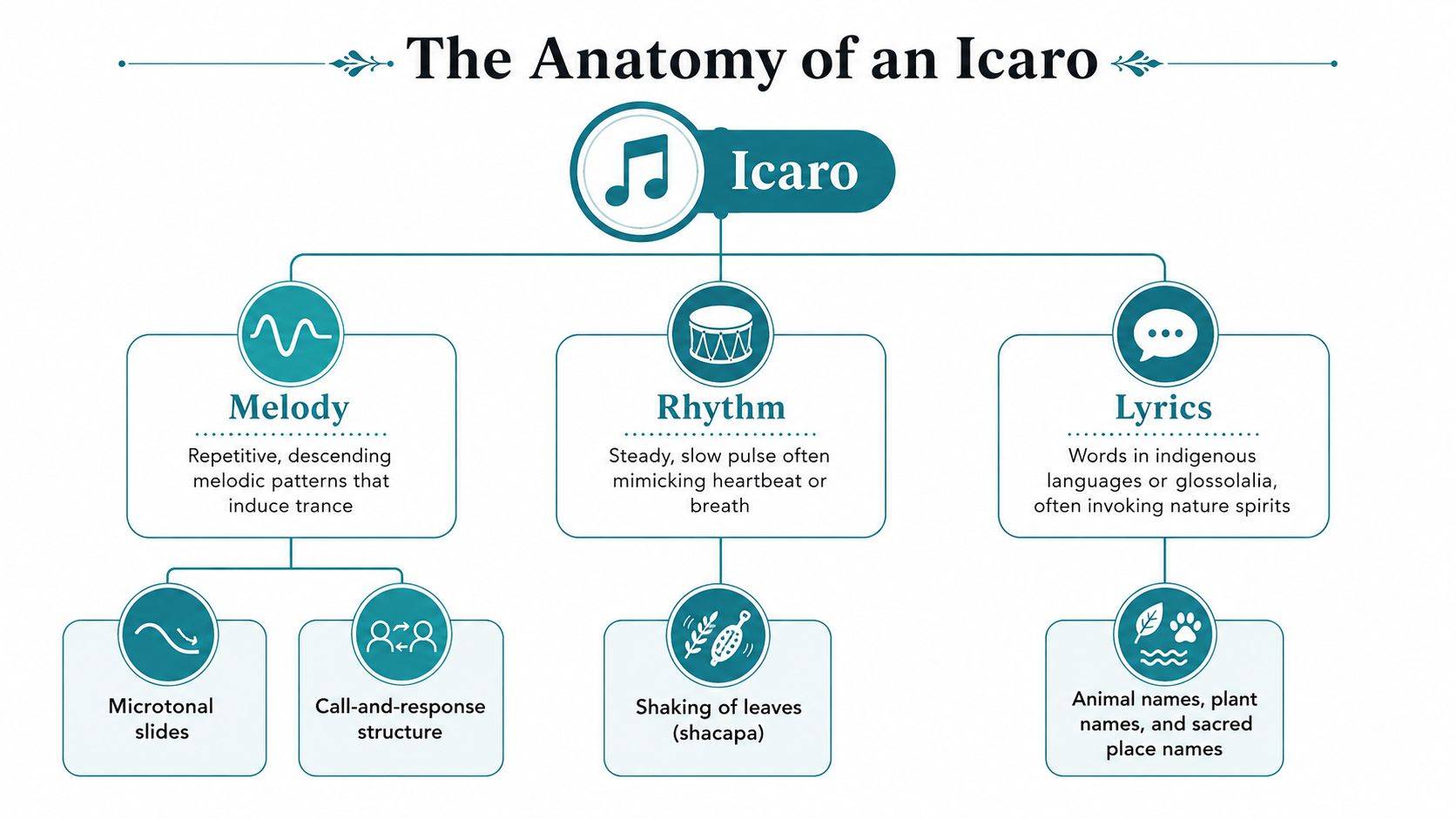
An icaro isn’t defined by one universal musical formula. Amazonian traditions differ by community, healer, language, lineage, and ceremonial context. Still, listeners can attend to several recurring dimensions: melody, rhythm, vocal expression, lyrics, and intention.
Melody Creates Continuity
Many icaros use repetition, descending contours, sliding tones, or closely related melodic phrases. Repetition gives the participant something stable to follow, while small variations keep the song responsive rather than mechanical. A healer may return to a phrase several times, change its intensity, or move toward a new melodic area as the ceremony develops.
Listeners may also hear vocalizations that resemble wind, water, birds, or other natural sounds. Those sounds shouldn’t be treated as theatrical imitation without context. They may express a relationship with the natural world, invoke a particular presence, or help shape the felt environment of the ceremony.
Rhythm Organizes Attention
Rhythm can guide attention through a steady pulse, changes in pacing, or the movement of a shacapa. A consistent pattern may support grounding, while a denser or more animated texture may accompany heightened emotional or visionary activity. It’s tempting to assume that every healer deliberately matches a participant’s heartbeat, but the available evidence doesn’t establish a universal technical protocol of that kind.
A more careful interpretation is that rhythm offers bodily orientation. Breath, movement, vocal cadence, and percussion can give the participant a sensory reference point. When the mind becomes absorbed in memory or imagery, the rhythm may help maintain contact with the ceremony.
Lyrics Carry Relationships
Icaros may include words connected with plants, animals, sacred places, ancestors, or spiritual beings. Some songs use Indigenous languages, while others include vocal sounds that listeners can’t translate into ordinary speech. Literal comprehension is therefore only one possible route into the song’s meaning.
A participant can listen for changes in tone, repetition, emphasis, and emotional effect without claiming to understand the song’s cultural content. Anyone seeking a more detailed introduction to ceremony and song can consult this resource on the sacred power of icaros in Ayahuasca ceremonies, while remembering that an explanatory article cannot substitute for relationship with a living tradition.
The most useful question isn’t whether an icaro contains a single hidden code. It’s how the healer combines musical structure, ceremonial intention, and responsiveness to create a field in which participants can stay oriented while encountering complex inner material.
Therapeutic Mechanisms and Emotional Regulation
The therapeutic importance of medicine songs becomes clearer when the song is understood as an intervention in attention. During an Ayahuasca ceremony, participants may encounter intense memories, shifting emotions, bodily sensations, and symbolic imagery. An icaro can provide an orienting focus that helps the person relate to those experiences without becoming completely absorbed by them.
A qualitative interpretive phenomenology study involving 6 participants at Peru’s Centro Takiwasi reported that icaros were therapeutically significant because they modulated the Ayahuasca-induced altered state, increased feelings of safety, and helped participants work through difficult memories and emotions. The study record on participant experiences at Takiwasi describes the songs as a structured sensory intervention that shaped emotional regulation and meaning-making.
From Disorientation to Orientation
A separate qualitative study of Amazonian curative songs found that participants experienced icaros as an orienting focus that guided the ceremony and reduced disorientation. The authors connect this experience with a neurophenomenological possibility called decentering, where a person observes thoughts, memories, and feelings as experiences rather than treating each one as an absolute command. The study of participant experiences of icaros presents music as a possible support for introspective and meditative states.
This doesn’t prove that every icaro produces the same response. It also doesn’t establish that music alone causes therapeutic change. The studies are qualitative and interpretive, so they’re especially valuable for describing how participants experience the songs, while leaving causal questions open.
Safety Can Be Musical and Relational
A song may increase a sense of safety through several overlapping channels:
- Predictable structure: Repeated phrases provide continuity when internal experience feels unstable.
- Human presence: A live voice signals that another person remains attentive nearby.
- Emotional permission: Changes in melody and intensity may allow grief, fear, relief, or joy to emerge without requiring verbal explanation.
- Meaningful direction: The song can help a participant remain connected to the ceremonial process while memories surface.
A regulating song doesn’t erase difficult material. It can help a person meet that material with more orientation and less isolation.
The field still lacks strong causal evidence, standardized protocols, and controlled comparisons of song types, timing, volume, and healer style. Research on music in psychedelic therapy has focused far more on psilocybin and MDMA than on Ayahuasca, while Ayahuasca-specific music research remains comparatively thin. The available literature also suggests that more music isn’t automatically better. Responses are individualized and context-dependent, and an icaro may intensify difficult material rather than soothe it.
Cultural Ethics and Modern Translation
The growing interest in medicine songs creates a difficult question. Can a sacred song be transferred into a modern clinical or retreat setting without losing the relationships that give it meaning? A melody can be recorded, copied, and placed into a playlist, but cultural authority, ceremonial responsibility, language, lineage, and reciprocity don’t travel so easily.
Decontextualization happens when a song is presented as a universal relaxation technique while its Indigenous origins and permissions disappear. It also occurs when outsiders learn a few sounds, assign their own spiritual meanings, and present the result as an authentic healing practice. Respect requires more than crediting a source culture in a description.
Translation Has Limits
Recent review literature encourages psychedelic-assisted therapy research to give greater attention to traditional forms such as icaros and Santo Daime hymns, while also emphasizing how limited the evidence remains regarding their use outside ritual settings. Researchers still have few answers about whether songs work similarly across languages, whether recorded tracks can substitute for live singing, or how they function in non-Indigenous clinical environments. The review of music implementation in psychedelic-assisted therapy places these questions within a wider discussion of clinical music protocols.
Standardization may help researchers describe what happens in a session, but it can also remove the responsiveness that defines live ceremonial singing. A fixed playlist can’t perceive a participant’s breathing, posture, distress, or changing relationship with the room. Conversely, an unstructured use of live song can create risks when facilitators lack adequate training or assume that tradition alone guarantees safety.
A culturally responsive approach should ask:
- Who has permission: Does the singer have a legitimate relationship with the song and the community connected to it?
- What remains intact: Are language, context, ceremonial purpose, and attribution being preserved?
- Who benefits: Do Indigenous knowledge holders receive recognition, control, and fair compensation?
- What safeguards exist: Can participants pause, ask questions, or decline the music without pressure?
Readers involved in therapy, education, or facilitation may benefit from this guide to culturally responsive counselling as a broader framework for examining culture, power, and client autonomy. A related discussion of Ayahuasca and sacred reciprocity can deepen reflection on exchange and responsibility.
The ethical standard is demanding but practical. Modern practitioners should avoid claiming ownership over Indigenous forms, should distinguish adaptation from transmission, and should explain clearly when a practice has been inspired by a tradition rather than authorized by it.
Guidance for Respectful Engagement
Respectful engagement begins before the first recording or ceremony. A seeker needs to learn the difference between hearing a song and entering a tradition. Listening can offer appreciation and orientation, but it doesn’t confer cultural authority, ceremonial competence, or permission to perform.
A grounded approach includes several deliberate habits.
Listen Without Extracting
The first step is attentive listening. Notice the song’s rhythm, repetition, pauses, vocal texture, and effect on attention. Avoid immediately treating every sound as a technique to copy or every lyric as a personal affirmation.
Context matters more than novelty. Seek information about the singer, community, language, purpose, and permissions connected with a recording. If those details aren’t available, the responsible response is curiosity rather than confident interpretation.
Learn Through Relationship
A person who wants to study or perform medicine songs should seek instruction from an appropriate teacher and accept that some songs may not be available for public learning. A teacher may explain what can be shared, what belongs to a particular lineage, and what responsibilities accompany performance.
Learning a melody is easier than understanding the obligations surrounding it. The latter develops through time, observation, service, correction, and humility.
Evaluate Ceremony Settings Carefully
Participants can ask practical questions before joining a ceremony:
- Who leads the work: What training, lineage, and experience does the facilitator describe?
- How is consent handled: Can participants decline particular songs, touch, or interventions?
- What support is available: Does the setting provide preparation, emergency planning, and post-ceremony integration?
- How are communities honored: Does the organization explain its relationships with Indigenous teachers and source communities?
- What happens after the ceremony: Are participants encouraged to reflect without being pushed toward grand conclusions?
MedicineSongs.com can serve as a starting point for seekers looking for educational material and a more informed vocabulary. No website, recording, or retreat directory can replace personal discernment, direct accountability, or qualified care.
The safest attitude is neither romanticization nor dismissal. Medicine songs deserve openness, but openness should include boundaries. A listener can value their beauty while refusing to flatten them into generic wellness content.
Integrating the Resonance
After a ceremony, a recurring icaro may return in memory as a cue for steadiness, reflection, or emotional recognition. Rather than forcing the song to reproduce the ceremony, a participant can sit, notice the remembered rhythm, and write down what feelings or memories arise. This turns recollection into observation rather than escape.
Integration works best when the song remains connected to practical life. A person might pair quiet listening with journaling, gentle breathing, or a conversation with a qualified support person. A resource on Ayahuasca integration practices can help organize that reflection.
Medicine songs are living practices, not disposable recordings. Their lasting value depends on the relationships, permissions, and responsibilities that surround them. Seekers who want to explore further should begin with reputable education, choose ceremonial settings carefully, and approach every song with patience, cultural respect, and clear attention to personal safety. For grounded resources on Ayahuasca traditions, preparation, and integration, visit Ayahuasca.com and continue the learning before making the next step.
Disclaimer: The information provided on Ayahuasca.com is for educational purposes only and is not intended as medical advice, diagnosis, or treatment. Ayahuasca is a powerful traditional Amazonian medicine and may not be suitable for everyone. Always consult with a qualified healthcare professional before making decisions related to health, mental well-being, medications, or the use of Ayahuasca.